A Short Story from the Archive
Targeted Affair
Dr. E. M. Fraser-MacDonald and Ilse Wilhelm, of Schweinfurt
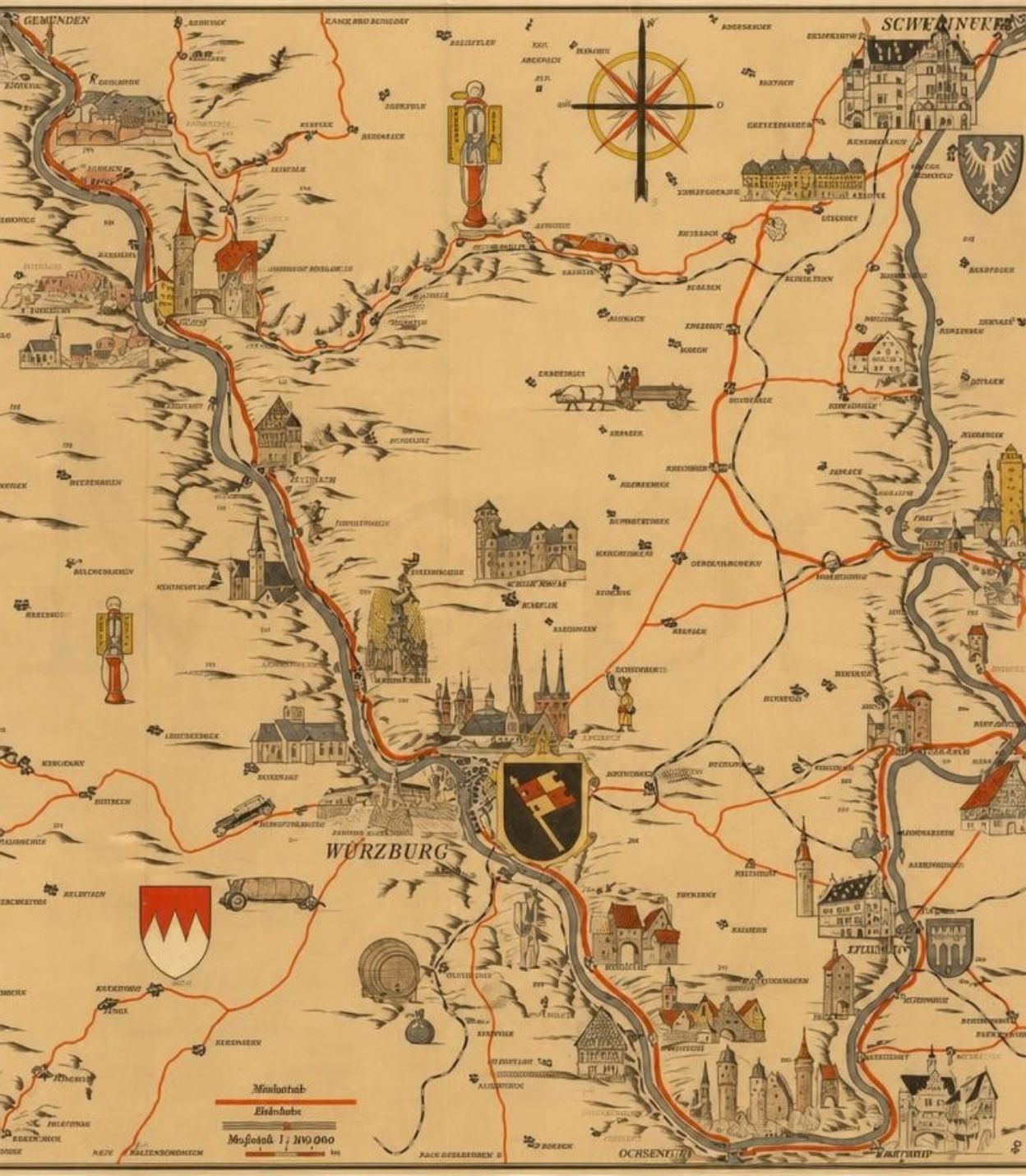
A touring map of the Main valley, of the kind sold at the station and carried folded in the door pocket of an open car, 1936.
Voss Court, Hampshire, Autumn 1951
It was a wet Tuesday, some weeks after the business with the Tissot had settled back into the ordinary rhythm of the house. Fraser-MacDonald had spent the morning at the Jefferson desk working through the Bradford Bainbridge folder Greville had left him, and the afternoon doing very little with it, his glass eye turned toward the window and the rain rather than the page.
The project, such as it was, amounted to five years and counting of sorting through the papers of the family's most celebrated forebear, Sir Philip Voss, a Royal Navy captain who had made his name against the French in the Napoleonic wars and come home to a baronetcy and more paper than any one house had a right to generate. Sir Reginald wanted it bound into a private edition for the family's own shelves, nothing the public would ever see, and had been patient, so far, about how long that was taking.
Above him, Greville was three boxes into a crate that had come down from the old nursery, cataloguing with the patient thoroughness of a man two years into a job he'd expected to outgrow in six months. Fraser-MacDonald could hear him up on the ladder, the small sounds of paper and string, the occasional pause when something was worth a second look.
The pause, this time, went on rather longer than usual.
Then the footsteps started, fast, down the brass spiral stair that connected the two levels of the library, the one Fraser-MacDonald himself had not trusted his hip to in three years.
"F-M." Greville came off the last step still holding it flat across both palms, the way a man holds something he isn't sure is his to hold. "Do you recognize this map?"
Fraser-MacDonald didn't take it. He didn't need to. The rake-crest in the corner had gone the orange-brown of a scab, and he knew, before his eyes had finished the word Schweinfurt, that his hands thought they remembered the weight of it.
• • •
Schweinfurt and the Main Valley, 1935 to 1936
She had found him at a party in London, or he had found her (neither of them ever settled which, in all the letters that came after), a widow of the last war, which in 1935 still meant something specific and quietly devastating about a husband at Verdun or the Somme or one of the dozen places the century had decided to empty out. Ilse Wilhelm. Forty-three to his forty-nine, though she carried the arithmetic better than he did, and entirely unconvinced that widowhood obliged her to anything. She laughed at the wrong moments and meant it. She left for Schweinfurt a fortnight later and wrote to him within the month, and by July he was on a boat, then a train, then, astonishingly, in the passenger seat of her open car with the hood down and her hair coming loose from its pins and the whole green corridor of the Main valley unspooling ahead of them.
She drove like the road belonged to her family. He let her.
She was, it turned out, the perfect guide for a man writing a commerce history, though he hadn't married the idea of her for her usefulness and felt faintly guilty every time he opened his notebook in the passenger seat. At Gemünden she slowed the car on the bridge so he could see where the Saale and the Sinn came into the Main together, and told him the town had made its living off the river for six centuries before anyone thought to build a railway, timber rafted down from the Spessart forests, whole trunks lashed together and floated to Frankfurt and beyond, long before anyone needed a locomotive to do the same work badly.
He had bought a touring map at the station, Schweinfurt and the Main valley, a Franconian rake in the corner, and by the end of the week it was soft at the folds. He circled each town they stopped in. When she turned off onto roads that weren't printed, a farm track to the Silvaner terraces, a ford below Kitzingen, he traced them in pencil with the map open on his knee. "You'll get us arrested for cartography," she said. In the margin he wrote what the monograph needed: wagons, works, who bought from whom.
In Würzburg they took a room at an inn called the Raupenhelm, across the Alte Brücke at the foot of the Marienberg fortress. They spent two days doing what every visitor to the city was obliged to do. First the fortress itself, climbed in the heat and worth it for the view alone. Then the Residenz, all gilt and ceiling fresco and a staircase Ilse said no sane architect would have attempted twice. The bridge and its towpaths came next, with barges still working both banks the way they had for centuries. Last were the vineyards, terraced up slopes steep enough that F-M couldn't imagine harvesting them without a rope.
"You've gone quiet," Ilse said.
"I was thinking that none of this had to be useful. It only had to be impressive."
"And now?"
He didn't answer that one. He didn't need to.
On their second afternoon they drove a few miles down the river and ate on a slope above Zell, where the vines stopped and the grass was warm. She had brought Brötchen, a piece of Käse, and two apples, and she sliced the apples with a pocketknife into a clean handkerchief.
"That is the best apple I have ever tasted."
"Unterzell," she said. "From the old priory orchard, this year's. A lot of witch stories come out of that place."
She said it in the same voice she used for a vintage. A seed had caught on her lower lip. She took it off with a fingertip and flicked it into the grass. The Main was bright below them. He did not ask about witches. He kissed her instead, and she laughed at him for it, and the afternoon went on being an afternoon.
They crossed back over the Alte Brücke on their second evening, and Ilse told him the bridge, or something very like it, had stood on that exact spot for more than eight hundred years, binding the bishopric's two banks together long before anyone called it convenient. Commerce, she said, had never once cared which side of the river the cathedral stood on.
She also told him, with the same even voice she used for wine vintages, that the city had burned something like two hundred people as witches in a span of five or six years in the 1620s, some of them in the Marktplatz, in front of the whole town.
"Good God."
"It was a long time ago."
"It couldn't happen now. Not here. Not to people who've had electric light and a railway timetable for fifty years."
She didn't answer that one directly, which he didn't think anything of at the time, and only remembered much later, turning it over the way you turn over a thing someone said that you failed, completely, to hear correctly the first time.
In Volkach and Kitzingen it was wine again, always wine, the Mainschleife's vineyards terraced into the hillsides the way they'd been since the monks first planted them, and she made him taste the difference between a Volkach Silvaner and the Stein before she'd let him write either down.
She knew her own town better than any of it, naturally. More goods wagons moved through Schweinfurt on an ordinary day, she told him, than through any of your large industrial towns back home, though nobody local had ever bothered writing the figure down for an Englishman to check it against. She said it the way another woman might recite a recipe, from memory, without having to think about where the number came from.
"You're testing whether I made that up."
"I'm admiring it."
"Test it anyway. It's close enough for your book either way."
It was, as far as he was ever able to determine, close enough.
By the time they'd worked their way back toward Schweinfurt she had been, within the space of a single afternoon, his chauffeur, his guide, his research assistant, his editor, his drinking partner, and, not incidentally, the first reason in a decade he had wanted to finish a book rather than simply stop disappointing the people waiting for it.
They took the inns as they came, the kind with a low beam you ducked for and a landlady who'd decided within ten seconds whether she approved of you, and worked their way from one Weinfest to the next, from one hillside Biergarten to the next, Franconian Silvaner in Bocksbeutel bottles and her shoulder warm against his in the dark after. They hiked when the mornings were cool enough for it. On some days they didn't leave their room except for meals, and didn't always manage that.
The Biergarten above Randersacker had the best view in the valley and the worst luck that afternoon. A fruit seller, an older man with a handcart, had been setting up in the same corner near the gate for as long as anyone could remember, and the three young men in brown shirts who stopped at his cart didn't need to ask who he was. Everyone already knew.
It didn't take long. It never seemed to. One of them tipped the cart, almost lazily, the way you'd knock over a chess piece you'd already decided to lose, and the apples went everywhere, and the old man went down on one knee trying to catch what couldn't be caught, and the young men laughed in the particular register of men who have already confirmed no one is going to stop them.
F-M half rose from the table. Ilse's hand was on his wrist before he'd finished the motion.
"Sit down."
"Ilse, they're going to..."
"They're going to finish and leave, and if you stand up, they'll still finish, and now they'll remember your face too." She said it quickly, quietly, not looking at the cart at all anymore but at her own hands on the table. "Don't stare. It draws them."
He sat. He watched her instead, and that was somehow worse than watching the street, because her face had arranged itself into an expression of careful, practiced neutrality that he understood, with a small cold drop in his stomach, she had used before. Not once. Not twice. A face she kept in reserve for exactly this.
The young men moved on. The old man gathered what fruit hadn't rolled into the gutter and went on setting up as though nothing had happened, which was its own kind of fluency.
Ilse signaled the waiter for two more beers as if nothing had interrupted the afternoon at all.
"You knew that was coming," F-M said.
"I knew it was always coming." She turned her glass a quarter turn on the table, watching the foam settle rather than looking at him. "It was never really about him, F-M. They'd have found someone. The point isn't the apples. The point is that every table out here just learned what happens if you stand up, and now none of them will, not today, not next week either. It's efficient, if you think about it. One cart. An entire Biergarten taught a lesson, and no one had to touch anyone who matters."
He hadn't known what he'd expected. Not this. Not the fluency of it, the way she'd reduced a man's humiliation to a mechanism and seemed almost to admire the economy of the thing, the way she might admire a well-run line at the works.
Her family's money came from the Wilhelm Dye and White Lead Company, two generations old by then, the works still turning out the pigment the whole world used without ever learning to say its name properly: Schweinfurt Green, copper and arsenic cooked down into the brightest color anyone had found a way to manufacture. She was prouder, if anything, of a different set of works entirely. She'd point out the roofline of the Kugellager sheds from the balcony the way another woman might point out a cathedral, and tell him, not quite joking, that half of Europe's machinery turned on bearings made within walking distance of her bed.
He was meant to be writing a monograph, The History of Commerce in the Main River Valley, the kind of academic posting that let a man disappear for a term or two in the name of research, and that his college would forgive almost anything for, provided he came back with a chapter to show for it. He had never in his life felt less like a man with a chapter in him.
But September came whether he'd written it or not, and the leave didn't extend itself for reasons of the heart, however much of the heart had been spent by then. He stayed. Ilse had a flat in town with a third-floor balcony over the street, and in October, a full fortnight after his term should have begun, he was standing on it the morning the tanks came through.
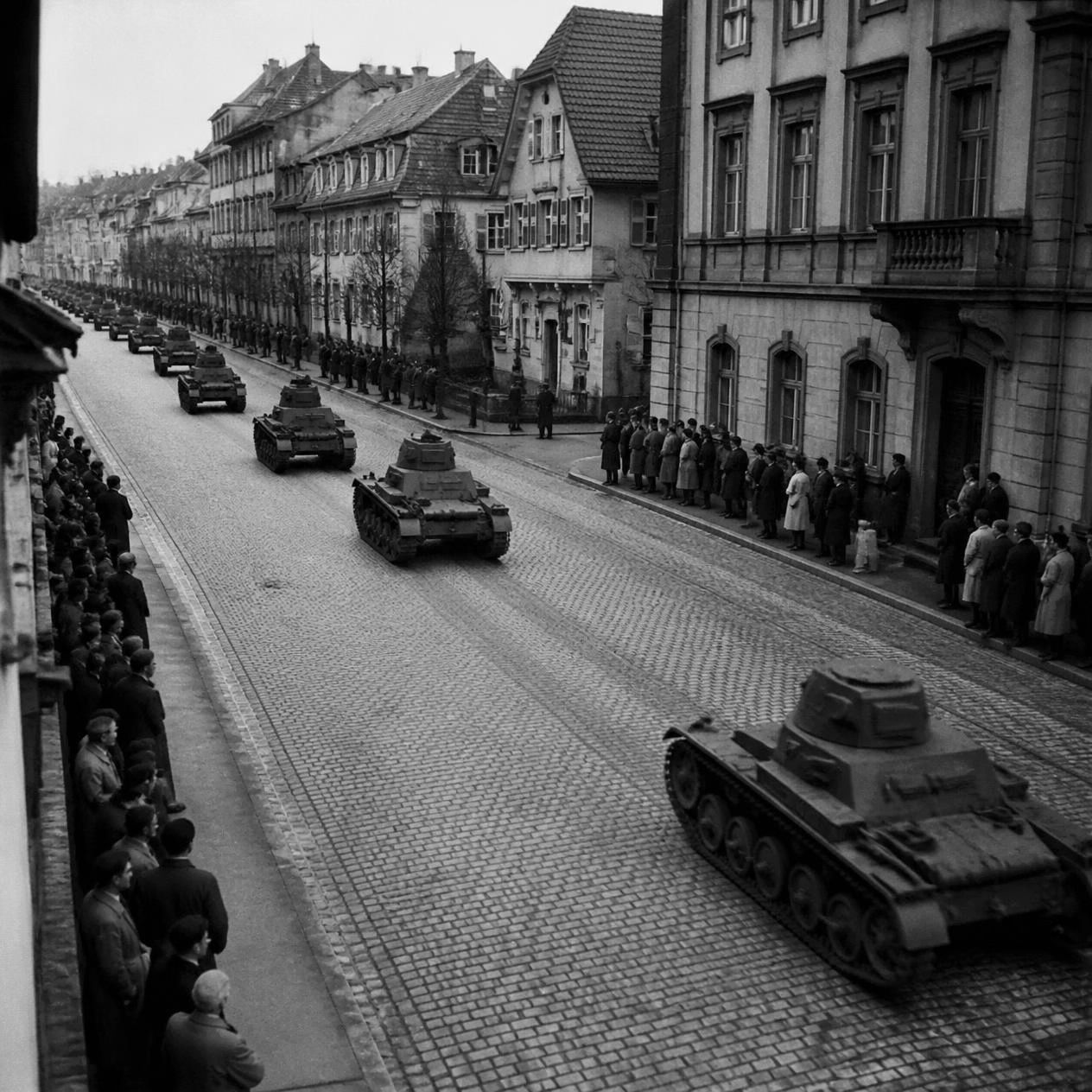
Panzer-Regiment 4 passes beneath Ilse's balcony, October 6, 1936.
They were smaller than he'd expected, boxy little machines on tracks that clattered and shrieked against the cobblestones loud enough to rattle the glasses on the balcony rail, a crew of two visible through the open hatches, twin machine guns rather than the great cannon he'd half pictured, and more of them than he could easily count, column after column grinding down toward the Marktplatz trailing exhaust and the smell of hot metal.
She had her arms folded on the balustrade, chin resting on her wrists, and for the first ten minutes she watched the column come through without saying anything at all, which from Ilse was its own kind of statement.
"There," she said finally, nodding at nothing in particular. "That's the Lord Mayor. He sold my grandfather his first delivery contract and never once paid on time."
"You don't sound proud of him."
"I'm not proud of him. I'm proud of them." She tipped her head toward the tanks, the small shapes crawling between the buildings, engines echoing flat off the stone. "Half of what turns in every one of those came out of a shed you could walk to from here. Bearings, races, the lot. They'll go nowhere on petrol alone, F-M. Every wheel, every track roller, every gear in the transmission wants steel balls running true, and nobody else in the Reich makes them in that quantity. Stop the works for a week and you'd have a parade of very handsome, very stationary boxes. Nobody in Berlin thinks about Schweinfurt. Everybody in Berlin depends on it."
"That's not nothing to be proud of."
"No." She didn't look at him. "It isn't."
A cheer went up somewhere below, ragged, and a child's voice cut through it, too shrill to make out words. Ilse's hands tightened slightly on the rail.
"What," he said.
"Nothing."
"Ilse."
"My husband's regiment had a parade like this. In 1914. My mother-in-law kept the photograph on the mantel for a year before she couldn't anymore." She said it without any particular weight, the way you'd mention weather that had already passed. "They always look like this at the start. Very tidy. Very loud."
He wanted to say something and found he had nothing that wasn't either too small or too large for the moment, so he put his hand over hers on the rail instead. She let him, which surprised him, and didn't look away from the street.
"I'm not frightened of tanks, F-M," she said, after a while. "I helped build half of what's inside them. I'm frightened of how satisfied everyone looks watching them go by."
Below, the column kept moving, and the noise of it filled the square the way water fills a basin, evenly, without hurry, as if it had all the time in the world to get where it was going.
He asked her to leave with him the night before he went back. In the apartment, with his case already half packed on the bed between them like a third person in the room.
"Come with me. Just for a visit, to start. See how it suits you."
"Tasting it first, like wine." She was folding a shirt he'd already folded badly, doing it over without comment, which was somehow worse than if she'd said something. "And if it doesn't suit me, I come home to find what, that the lease has lapsed and someone else has the flat?"
"That isn't what I meant."
"It's exactly what you meant. You meant, come be unhappy somewhere smaller than this, and be grateful for the invitation." She set the shirt down. "Franz, the foreman at the works, his father is seventy-one years old and has been turning the same ledger pages since before my grandfather owned the building outright. Do you know what happens to a business when the owner leaves it to taste England for a season?"
"I know what happens to a woman who stays."
That landed wrong, and he knew it the moment it left him, but there was no way to call it back. She didn't raise her voice. She was worse than that when she was angry, she went very precise.
"You have known me four months. You do not know what happens to me. You know what happens to women in novels you've read, written by men who left." She picked the shirt back up, finished folding it properly this time, and set it into his case herself, which he understood even then was not a kindness but a way of ending the conversation with her hands instead of her mouth. "I am not leaving my grandfather's name over a door for a man who cannot tell me, honestly, that he isn't half in love with the idea of rescuing me."
"That isn't fair."
"No," she agreed. "It isn't. Shut the case, F-M. You'll miss the train."
At the station, because there was always, in the end, a station, she gave him a Bishop's Favor, pressed into his palm the way you'd pass someone something you didn't want customs to ask about, and told him only to keep it close and never to ask her where it had come from. He never did find out. He gave her a pair of pearl earrings, which felt, even as he bought them, like entirely the wrong kind of gift to set against hers.
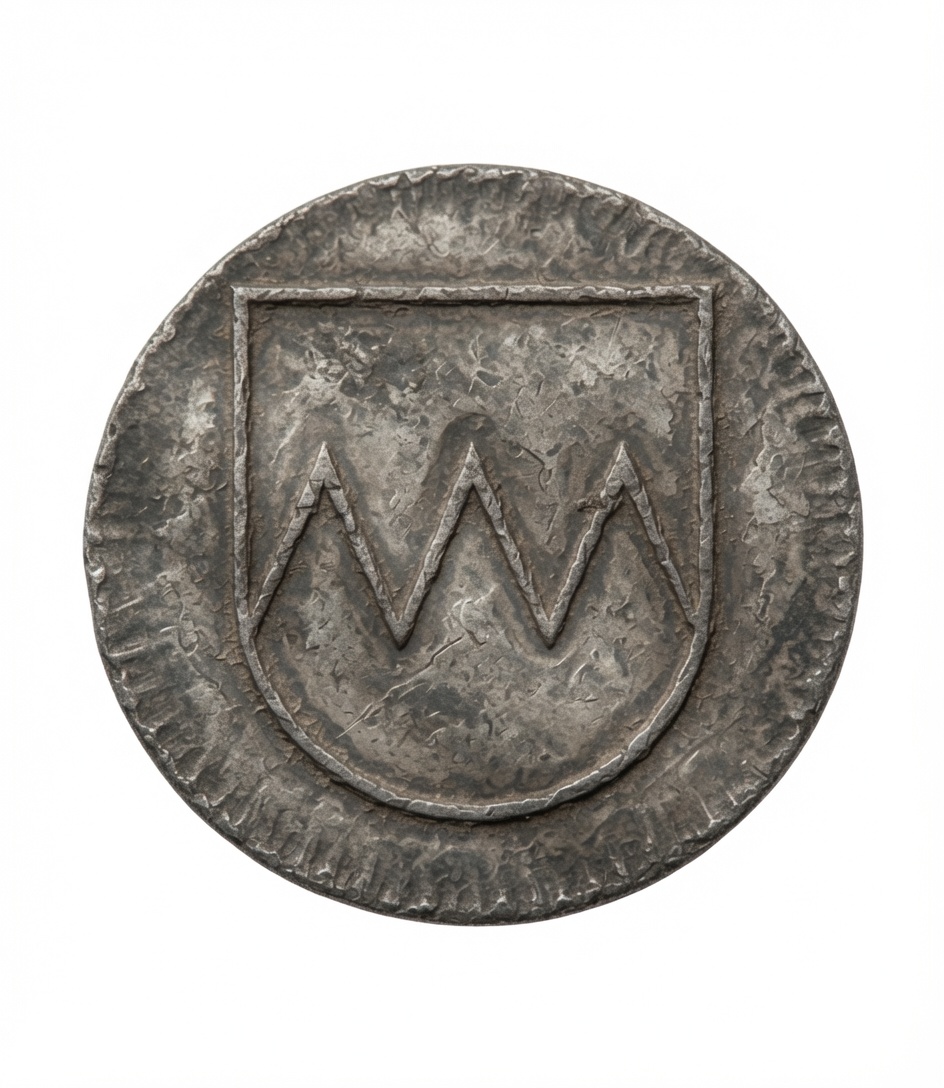
The Bishop's Favor, obverse. The same rake borne by the Prince-Bishopric of Würzburg, and by the token Anna is said to carry a century and a half earlier.
They corresponded for three more years, then a fourth in a thinner, more careful hand, and then the paper itself changed, and then nothing he could call an ending, only a silence he'd spent a decade deciding not to interpret.
• • •
London, March 1943
The room in the requisitioned townhouse had good light and bad coffee, and a trestle table covered edge to edge with reconnaissance photographs, grey rooftops seen from altitude, rail sidings like stitching across the frame. A single book sat apart from the photographs, its spine cracked from use, a slip of paper marking a page near the back.
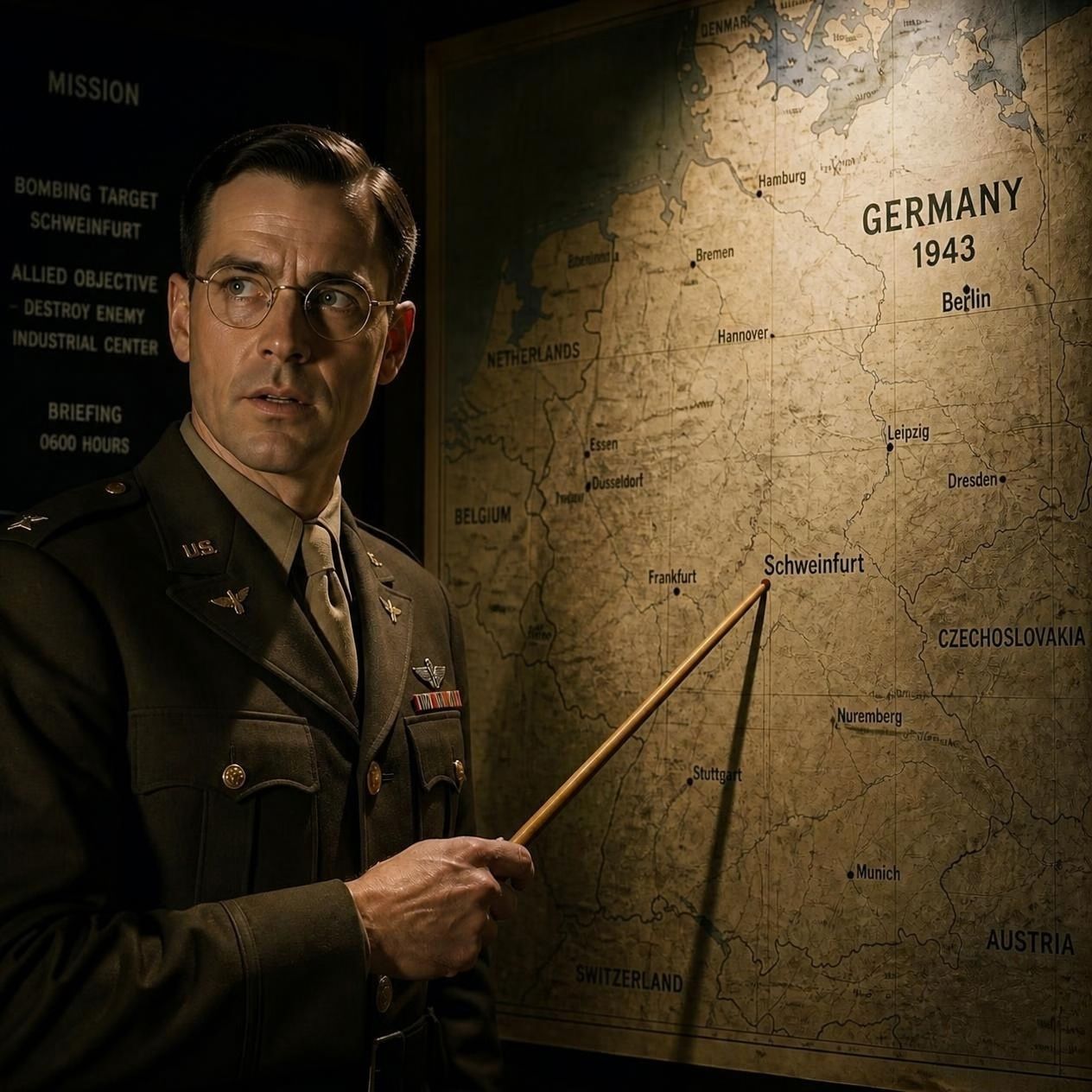
The target room, London, 1943. F-M on the major →
The American major doing the talking was younger than Fraser-MacDonald had expected, and more polite than he'd expected too, which somehow made it worse.
"Professor, we've all read your monograph. Some of us twice." He tapped the book's cover. The History of Commerce in the Main River Valley. "Best thing written on the region in English, as far as anyone here can tell. You know this town better than most of our own people know Pittsburgh."
"I spent some time there. Before."
"VKF and Kugelfischer, that's the primary and secondary." The major turned to the photograph, two marked rectangles close together, close to the river. "Rail yards here, here, and here. Photo recon gives us all of that well enough. What it doesn't give us is anything that isn't sitting out in the open waiting to be photographed. Subcontractors, smaller shops doing finishing work for the big houses." He glanced back at the book. "Your chapter nine, for instance. The Wilhelm Dye and White Lead Company. You go into more detail on that operation than on either of the ball-bearing works. Worth our attention, or just worth a historian's attention?"
Fraser-MacDonald looked at the question for longer than it required.
"Dye and pigment, mostly. The arsenic compound, Schweinfurt Green, sells as an insecticide. Increase a farmer's yield enough and you've fed more soldiers, however indirectly. The white lead itself is just a pigment, I'd think it of little direct use to you. It is a small works, but it ships by the wagon load, and it has its own siding onto the main line. I counted the wagons. The family wanted it in the book." He paused. "I wrote about it at length because I knew them. Not because of its size."
"Understood." The major made a note anyway. "From what you saw on the ground, what's the construction like, generally? We're thinking high explosive and incendiary both, and we'd like to know which does the most good where."
Fraser-MacDonald took his time.
"The larger works are concrete and steel, built to last and built to survive a certain amount of punishment. You'll want the explosive there, and even then you may not get what you're after in a single pass. The older buildings, the housing and the smaller commercial stock, those are timber-framed, tile roofs. Knock the tiles off with blast and you've opened the roof to anything that follows. They'd go up readily enough after that." He paused. "Of course, the workers live in those buildings. They're as much a part of the war effort as the machinery. The factories don't run without them."
"Our thinking exactly, professor."
The major moved on to prevailing wind and smoke cover, and then, almost as an afterthought, to Bamberg and Würzburg, whether Fraser-MacDonald had seen anything in either town worth a second look.
He answered truthfully. He had seen no targets of any significance in either place.
It was only when the major turned back to the Schweinfurt photograph, to confirm the approach heading one final time, that Fraser-MacDonald let himself find the Marktplatz, and from the Marktplatz, three streets north, the roofline he'd watched tanks pass beneath from a third-floor balcony seven years before, timber-framed, tile-roofed, exactly the kind of building he'd just finished describing.
"This block here." He didn't point. He made himself point. "That's residential. Close enough to the rail yards that you won't be able to keep it clean, if that's what you're asking."
"How close is close?"
"Two streets. Perhaps three."
The major made a note and moved on, and Fraser-MacDonald answered the rest of his questions in the same level voice, because the alternative was a silence someone in the room would have noticed.
A British colleague, Winters, walked him out afterward and offered him a cigarette he didn't take. He had the monograph tucked under his own arm, Fraser-MacDonald noticed, his own copy, well read.
"I got to the dedication on the train down," Winters said, not quite looking at him. "To Ilse Wilhelm, who brought the Main River Valley to life." He left a decent pause before he went on. "That must have been hard, writing that. Harder still, sitting in there."
"I have a duty, Winters," Fraser-MacDonald said. "It doesn't require me to enjoy it."
Winters nodded, and didn't say anything else, which was the kindest thing he could have done.
• • •
Schweinfurt, 1946
He did not go back until 1946. Sixty years old, and apparently still capable of being made a fool of by a city.
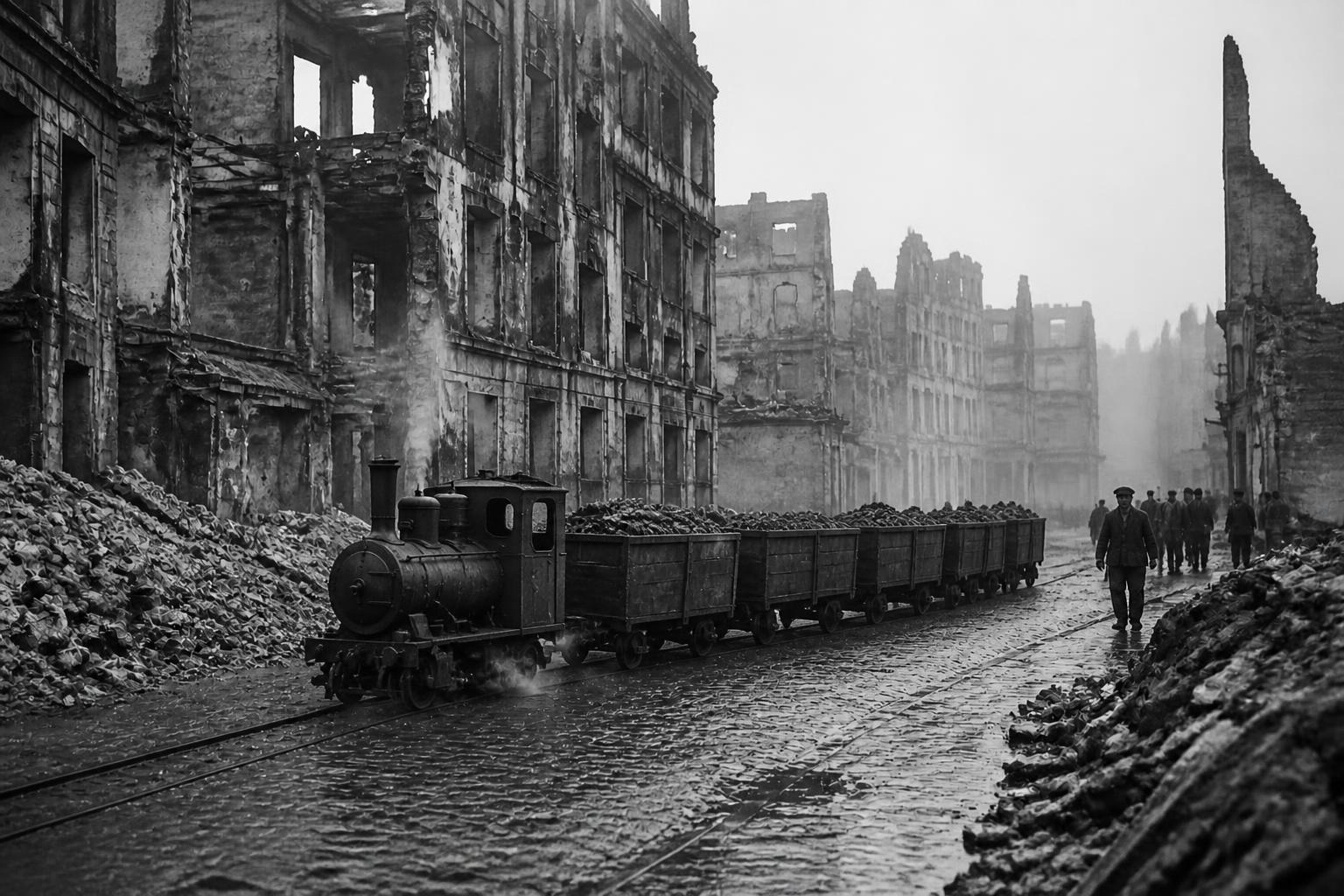
The Trümmerbahn, Schweinfurt, 1946.
The Trümmerbahn ran straight across what had been the Marktplatz, small cars of rubble rattling out on a track laid where the streets used to be. Lines of women passed bricks hand to hand, knocking off the old mortar with hammers and stacking them in tidy cubes, and not one of them looked up at a man in a good English overcoat.
He recognized nothing. That was the first discovery. He had carried the town in his head for ten years, the roofline, the balcony, the sheds, and none of it was there to be matched against. So he did what he had done once for a major in London. He found the Marktplatz, or the place where it ought to be, and counted three streets north.
It took him some time to understand that he had found her building by the same arithmetic he had used to lose it.
There was nothing to see. The metal had gone first, he supposed, the railings and pipes, the balcony rail he had once put his hand over hers on; then the furniture, the rugs, the frames and doors the last winters had needed for burning; and then the stone itself, taken away in barrows. A cellar hole filled with grey dust. A strip of kerb. Where she had stood and named the Lord Mayor in the street, there was sky.
The dedication was still in print in a few hundred libraries. It was now the only address she had.
He stood there until the cold reached his feet. He asked no one anything. The Favor was in his pocket and he held it, and the Trümmerbahn went by again, and the women went on passing bricks, and the whole of Schweinfurt seemed to him to have been carefully, patiently, and quite recently swept clean of her.
• • •
Voss Court, Hampshire, Autumn 1951
Greville watched something pass behind the old man's face, there and gone, the same involuntary flinch he'd seen once before when a car backfired in the drive. Fraser-MacDonald's hand found the Bishop's Favor in his waistcoat pocket, worn smooth now after fifteen years of this, and he held it for a moment before he let it go.
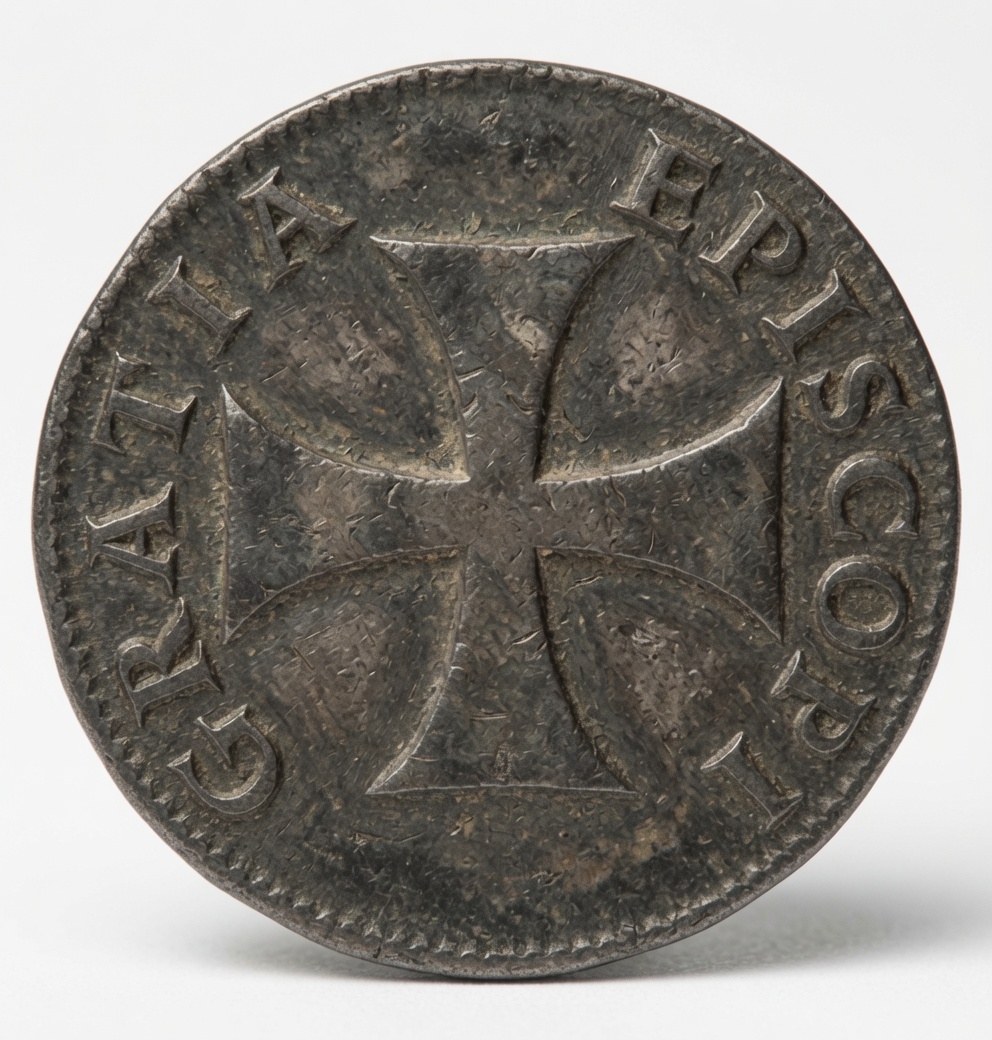
The Bishop's Favor, reverse. Gratia Episcopi, by the bishop's grace.
"Yes, Greville," he said. "I recognize the map."
He still had not taken it. Greville waited, the sheet flat across both palms, the rake-crest gone the orange-brown of a scab. Rain ticked at the library glass. Above them, on the upper gallery, the nursery crate stood open, string curled on the boards where he had cut it.
"It isn't mine."
Greville looked down at it, then back. "It's Schweinfurt."
"Yes." Fraser-MacDonald came around the desk at last. He did not touch the paper. He bent over it the way he bent over other men's proofs, looking for the mark that ought to be there. "Mine had every town we stopped in circled. And the back roads she took me down, in pencil, where the printed ones didn't go. Wagon counts in the margin. A note about the rail yards, which I should not have made and did." His mouth tightened. "This one is clean."
Greville turned it over, carefully, as if the sheet might be listening.
On the back, in an old-fashioned hand, a dip pen's thin line gone rusty, someone had written next to Würzburg: Priory of Unterzell. Below that, and not next to any town on the map, the same hand had written Fuenteovejuna, and under it a date, 1476.
"Unterzell," Greville said. He looked at the second line. "Fuenteovejuna. 1476."
Fraser-MacDonald still did not touch it. The Favor stayed in his pocket. He could hear her on the slope, in her vintage voice, this year's apples, witch stories, and he had not asked. She had never said Fuenteovejuna. He was not sure he had ever heard the word.
"Set it down," he said. "Not on the Bainbridge folder."
Greville laid it on the clear end of the Jefferson desk. The rain kept on at the glass. The two of them stood over an unmarked Schweinfurt, a priory, and a Spanish village nearly five centuries off the sheet, and neither of them said what that hand had been doing in a box from the old nursery.
What became of Würzburg, Schweinfurt, and Bamberg in the years after is addressed directly in Note 2 of the archive.
From the Archivist
Join the Archive mailing list
Occasional letters with new stories, early chapters and pictures from The Voss Papers. You can unsubscribe at any time.
The button opens a sign-up page. A confirmation email will follow; if it does not arrive within a few minutes, please check your spam or promotions folder. Voss Court Press LLC · 2875 W Ray Rd Suite 6 #105, Chandler, AZ 85224 · Privacy