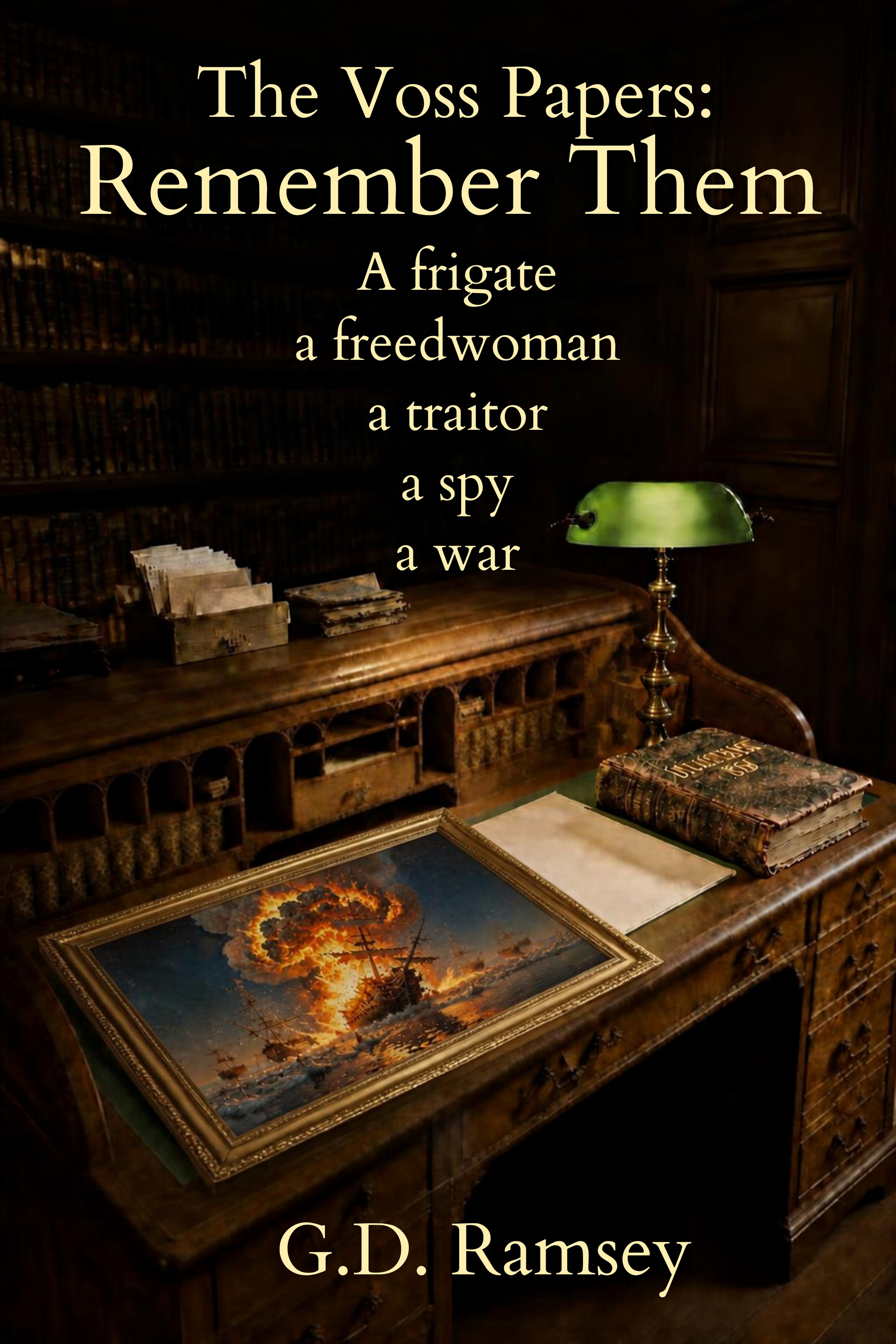
An Excerpt
Prologue: The Orient · Aboukir Bay, Egypt, night of 1 August 1798
Midshipman Philip Voss had not been long in the Navy, and had seen in that time a quantity of death and violence that would have been difficult to explain to the boy he had been before he joined. He had not been an innocent boy (Portsmouth produced few of those), but he had been, in the sense that matters, unacquainted with the actual texture of the thing. The Navy acquainted him rapidly and without sentiment. He had acquired, in the course of blockade and convoy work and one minor engagement off the Portuguese coast, the specific quality of attention that sailors develop when they understand that the sea has no interest in whether they are paying attention or not.
He was paying attention on the night of the first of August 1798.
HMS Goliath had gone around the landward side of the French line under Captain Foley. It was the move that broke the battle open, made in the last light of the evening, and it put the French fleet between two fires before they could respond to either. Voss had been at his station through the broadsides and the smoke and the chaos of a fleet action at night. That was different from a fleet action in daylight in the way that all things are different in darkness: louder, more confused, more dependent on the men immediately around you and less on anything you could see or plan for.
By nine o'clock the French line had broken. The battle was not finished (it would not be finished until dawn), but the shape of it was clear to anyone who had been watching. The French Mediterranean fleet was being destroyed. The ships that could move were moving. The ships that could not were burning.
The Orient had been burning for twenty minutes.
She was one of the largest ships afloat: one hundred and twenty guns, the flagship of Vice-Admiral Brueys, the pride of the French navy and the architectural expression of French naval ambition. She was two hundred feet long and she was on fire from her waist to her mizzen, the flames visible across the entire bay, casting a light that made the surrounding darkness more absolute by contrast. Brueys himself was dead, cut in two by a cannonball, and the ship was dying around the men who had not yet realized they could not save her.
Voss watched from the Goliath's forecastle, where he had charge of the two nine-pounders and the eight men who served them: a midshipman's share of the ship, and as much as anyone trusted a boy of eighteen with. Around him men were reloading, attending to the wounded, doing the dozen things that a gun crew does between broadsides. He did none of the things that were his to do for approximately ninety seconds, because he could not make himself stop watching.
He had seen ships burn before. He had not seen anything like this.
The fire moved up the rigging.
He committed it to memory, the way the Navy had taught him to: completely, precisely, without sentiment. It went into the archive a person builds once he understands that some things must be remembered accurately.
Penhallow came forward along the gangway at a run, one hand clamping his hat to his head. "Mr. Voss. The lieutenant's compliments. Wet the sails and wet the decks, and have every bucket you can find filled and standing by. When her magazines go, she will throw fire a long way."
"Aye aye, sir."
He put two men on the pumps and the rest on the buckets, and for the next several minutes he looked at nothing but the deck and the canvas above it. He was wet to the knees when he finished. It did not occur to him until later that nobody had said how far a long way was.
At approximately ten o'clock the Orient's magazines detonated.
The sound was not a sound. It was a pressure: a wall of air that hit the Goliath before the noise arrived and that Voss felt in his chest and his ears and the back of his throat simultaneously, before he heard anything. Then the sound. Then the light. It was so large and so sudden that it turned the night into day for miles, showing every ship in the bay in sharp relief, showing the coast of Egypt. In the fraction of a second before the debris began to fall, Voss thought he saw the pyramids themselves on the distant horizon, lit by the explosion of a ship.
Then silence.
The debris came down into it. Most of it fell in the bay and hissed and went out. Some of it fell on the Goliath: burning splinters, rags of canvas, a length of tarred rope that landed across the forecastle and lay there glowing.
It had landed a yard from the cartridge box by the starboard nine-pounder. The lid of the box was open, because the powder boy, who was perhaps eleven and had been looking at the sky like everyone else, had set it down with two cartridges showing. Beside the gun the slow match burned in its tub, in the ordinary, patient way of a thing that had been trusted all night.
Voss did not shout. Shouting makes boys run, and boys who run kick things. He stepped across, shut the lid with his foot, and emptied the nearest bucket over the rope. It hissed and went on smouldering, and one of the gun crew, who had been watching with the rest of them, threw a second over it before Voss could reach for another. He walked the match tub to the far side of the gun. Then he sent the boy below, at a walk, to tell the gunner's mate that the next cartridges were to come up when they were sent for and not before.
It took perhaps twenty seconds. Nothing happened, which was the entire point, and the only people who knew it were Voss, the boy, eight men who would not mention it, and one who would. The gun captain caught his eye and gave him a nod. "Well done, Mr. Voss," he said, quietly. Voss nodded back. He understood now why he had been told to fill the buckets, and how far a long way was.
Penhallow had seen it from the gangway. He stopped at Voss's shoulder on his way aft, close enough to be heard under the noise and no closer. "I saw what you did with the powder tin," he said. "Quick thinking. I'll let the Lieutenant know." Then he was gone again into the smoke, and Voss found that his hands, which had been perfectly steady with the bucket, had begun very slightly to shake.
The entire battle stopped. Every ship in Aboukir Bay (British, French, whatever French remained) went silent for ten minutes. No broadsides. No orders called across the water. Nothing. The crews of both fleets stood in the dark and the smoke and looked at the place where one of the largest ships afloat had been and was no longer.
Voss stood with them. He was eighteen years old. He had been in the Navy for two years. He would be in the Navy for thirty more. In those thirty years he would see a great many things that were difficult to see, and none of them would be the Orient.
It was the first lieutenant who broke it. He crossed the quarterdeck to Captain Foley and touched his hat. "Sir. I request permission to go below."
Foley did not take his eyes off the place where the Orient had been. "What for?"
"To bring my list of the French line up to date, sir."
"Permission denied. We still have a battle to fight." Foley was quiet a moment. "But your point is taken. I think we shall be striking a good many French ships from that list before this is over."
Penhallow heard it from the gangway, and repeated it in the berth for a month.
Then the first lieutenant turned forward, and he did not raise his voice. "That will do, gentlemen. The play is over, and the French have not all gone home. Mr. Voss, you will oblige me by looking to your guns."
"Aye aye, sir."
He went back to work.
The story that follows from here is Voss, Ox, and Eleanor's, and Élise's, and Davout's, and a city that none of them have met yet.