The Last Hexenkommissar of Würzburg
From the papers of Glew. Told by Ox Hargrove in the library at Voss Court, the winter of 1829. Ox asked that I not improve it. I have not. I retold it in my memoir of 1842. This is the 1829 telling, as Ox gave it.
You want a ghost story. I haven't got one. I've got a bookkeeping story, and I have never found the difference as large as people say.
There are two versions of this. Mrs. Hagan, who keeps the Raupenhelm at the foot of the Marienberg fortress, gave me one three years ago over a very good Silvaner. It is the one the town tells at the hearth. She has since put the careful version in a book, with the paper to back it, and I'll come to that at the end. Tonight you get the town's.
I. The Wood
It goes like this.
In June of 1749 the man Würzburg still called the Hexenkommissar tried a woman and burned her alive. The bishop had newer titles for the work. Nobody used them. The old word had been burned into the town a hundred years before, and a town does not retire a word that still frightens it.
She was a nun, the subprioress of a convent called Unterzell, which was known for its apples. In spring people came from all over to see the orchards in blossom. The charge was that she had visions of what was to come. In the warrant the Hexenkommissar called them ungodly, and added congress with the Devil and his minions, which is what they added when the first charge didn't seem to be enough.

Custom, I'm told, gave a woman in her position the mercy of the sword before the fire. He denied her that. He wanted her alive. He wanted a show, to frighten the town and, in his words, to suppress any devilry lurking in their hearts. So he had her burned at night, on the hill, three hundred feet above the city, where every window in Würzburg would have a view.
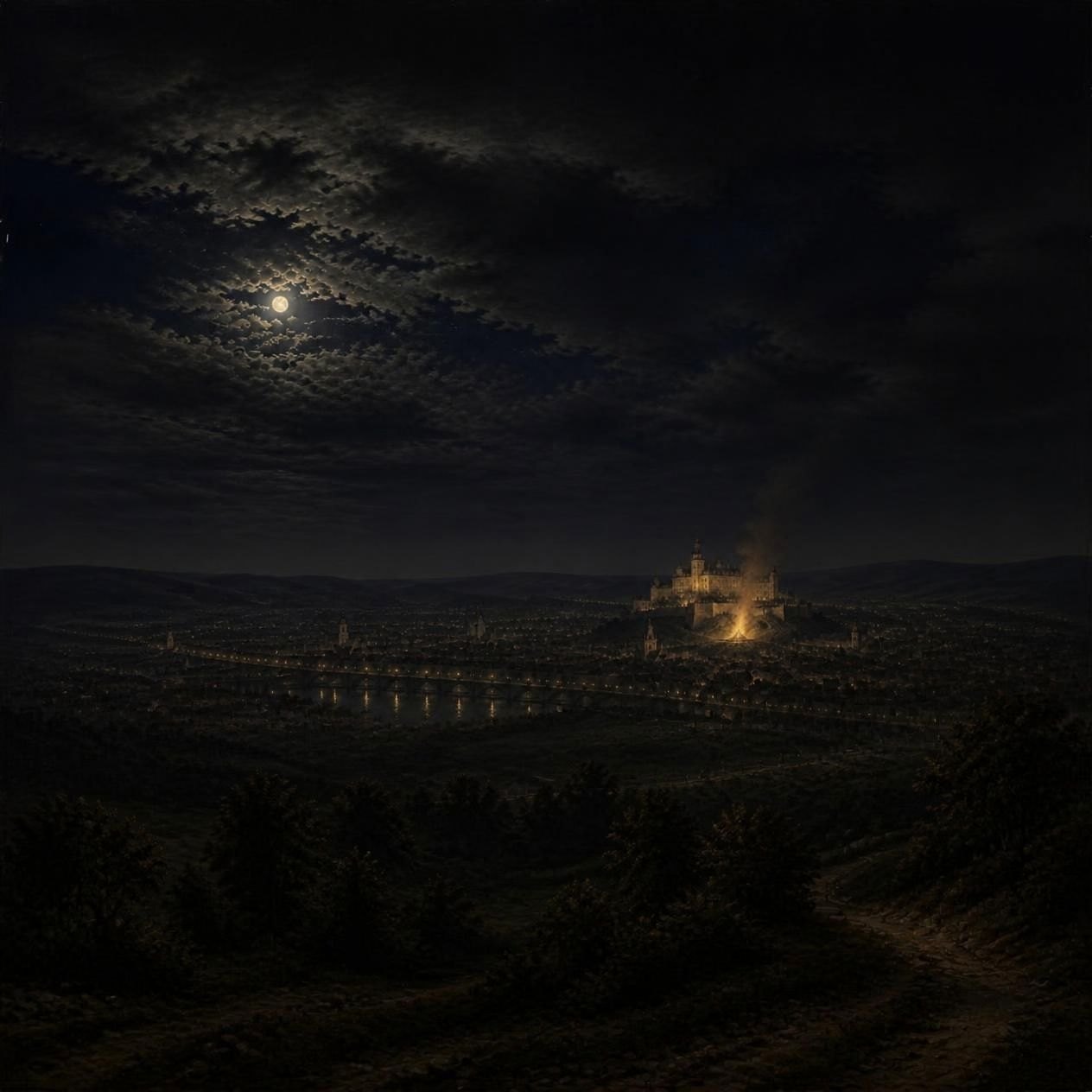
Nine loads of wood were hauled up to the yard under the fortress wall. The Hexenkommissar walked around the pyre the way a quartermaster walks around a stack of shot, and said, "Not enough wood."

The carter brought up a tenth load. He brought his daughter with him. She was eleven, and her mother was ill and being nursed by relatives, and there was no one to leave her with. He told her to sleep under the tarpaulin in the wagon bed. She was a good girl. She didn't sleep.
She didn't see what came next. She heard it.
The Hexenkommissar came out with two armed men and two priests, vicars of the cathedral, with the nun between them. Her hands were bound and her feet hobbled, so she could only shuffle. The two men tied her to the upright pole above the pyre. The Hexenkommissar asked whether she would repent.
She spat down at him. And in a firm voice she cursed him:
A pale man will come out of the west. Twenty years of soldiers, and then a summer without sun, and in that time you will be handed from one master to the next until no one remembers who the bishop was, or remembers your name.

Now, the Hexenkommissar held a belief that was sensible for his trade: a witch's curse does not take unless someone other than the cursed is left alive to carry it. He ordered his two men to cut the throats of the two priests and the carter. They did not hesitate. Then he ordered them to light the pyre.
It went up fast. She did not beg and she did not scream. She laughed, the way a witch is supposed to cackle, which I believe was the last thing he wanted from her. The whole city watched the blaze from below.
While the Hexenkommissar and his men watched the fire, the girl slid out from under the canvas and ran, and kept running until she reached her relatives' house. She told them that the Hexenkommissar had killed her father and the two priests. She did not tell them about the curse. That, she kept.
The news of the murders began to move through the town, the way news does when everyone has a reason to carry it.
The Hexenkommissar had a second problem. His two men had heard the curse as well. An hour later he drew up a fresh warrant. Murder of the carter and the two priests, men of the utmost purity, and, he added, the two men had boasted of congress with the accused nun. That should do it. They were beheaded at dawn, and their bodies were taken to the paupers' field.
He'd had a busy night. He slept very well, believing the curse had no one left to carry it. He had not counted the girl. I have been at sea long enough to know what happens to a man who doesn't count everyone aboard.
II. The Orchard
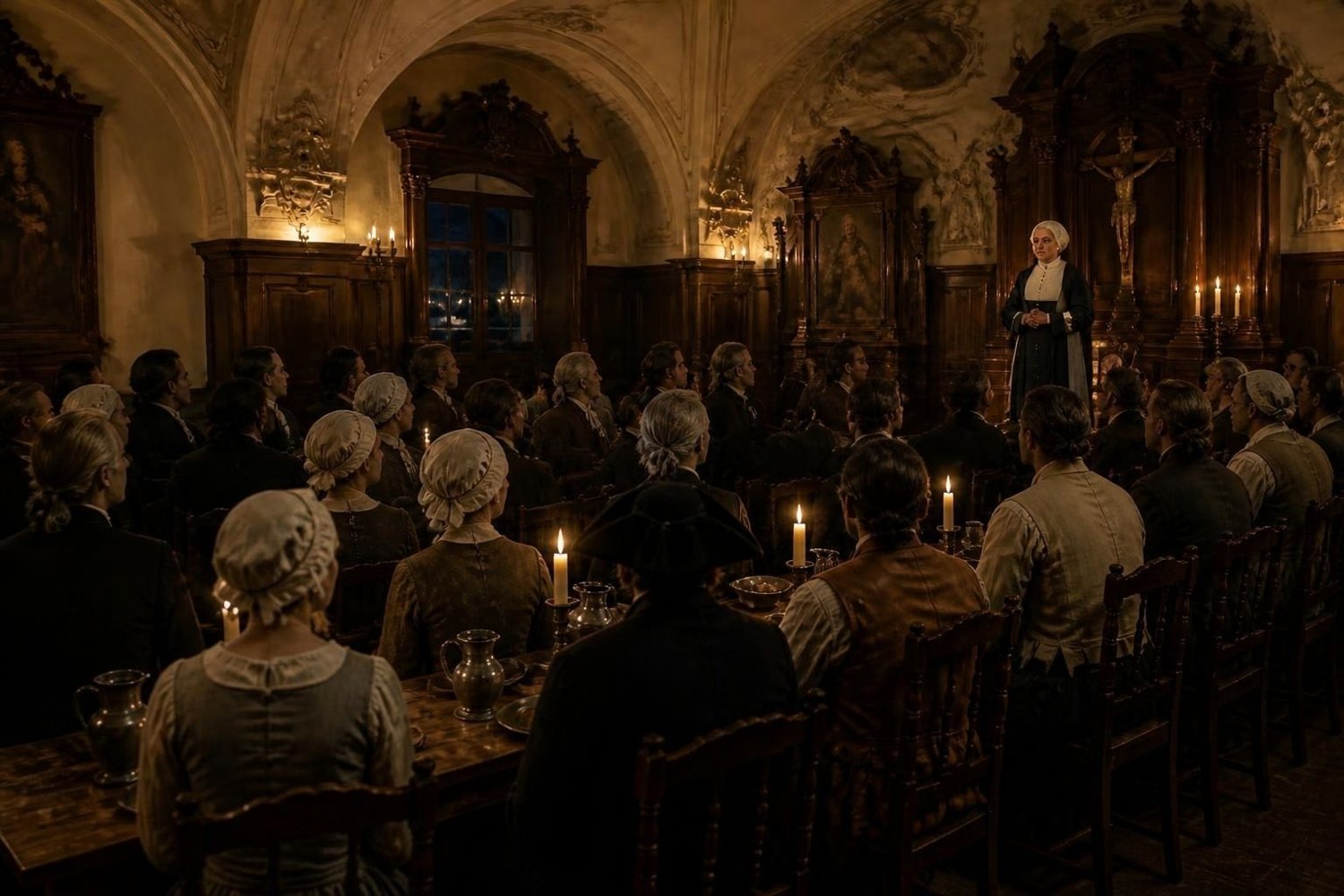
Over the next two weeks the story spread until it seemed everyone in the city had heard it. The prioress of the convent heard it too. On the feast of the Visitation, the second of July, she asked the town's clergy and lay leaders to meet her in the priory dining hall, and she began by telling them a story about a little town in Spain.
A priest went to the Hexenkommissar and told him that the priory meant to hold some satanic revel in the orchard that night. The Hexenkommissar wanted to bring men. The priest said no: too many boots, too obvious. "We need to see for ourselves. You'll be the first Hexenkommissar ever to witness such a ceremony. You'll be famous."
"Yes," said the Hexenkommissar. "I will be."
They crept up on the orchard on the night of the eighth, which is St. Kilian's, the city's own saint, when half of Würzburg is out of doors anyway. In a clearing at the center of the orchard there was a bonfire. They heard music and revelry. They saw the shapes of people dancing and cavorting before what looked like a maypole. They crept closer, to see better, and as they crept the priest gave a signal behind his back to the cartmen.
Six men came up behind them, fellow carters of the man who had been murdered. The priest had stepped aside. They took hold of the Hexenkommissar, gave him each at least one blow and one kick, and dragged him into the clearing.
The cartmen searched him and found a Bishop's Favor in his pocket. They gave it to the prioress. She gave it to the girl.
The music stopped. The dancers went still. The prioress stepped forward.
"Hexenkommissar, thank you for visiting our priory and our orchard. You are accused of the murder of my subprioress, of two priests of the cathedral, of a carter who was the father of five young children, and of your own two henchmen.
"You are condemned by the people. You will die at the hands of the people. You will burn. Alive.
"In memory of the subprioress, who tended the west block of this orchard, we have cut down those trees. We will build your pyre with their wood."
A long line of people came out of the dark, each carrying one log, and they built it. The carters tied him to the pole the dancers had circled. Each person took a stick and lit it from the bonfire. They stood around the pyre many ranks deep: carters, woodcutters, nuns, priests, merchants, constables, lawyers, everyone. There were three hundred sticks, one for each household within a mile of the orchard, and the prioress counted.
She asked whether he would confess his crimes. Instead he began to scream. That was his confession.

The prioress threw her stick on the pyre first, and the rest followed. Green apple wood is slow. For a while it only hissed and spat. Then hundreds of burning sticks won out. He never stopped screaming until the very end. In the morning there was a single shoe left in the clearing, a dancer's, and no one ever claimed it.
Every spring, when the orchards bloom, people remind each other to bless the subprioress by name. On St. John's Eve, when the midsummer fires are lit on the slope, they raise a glass to her and curse the last Hexenkommissar of Würzburg.
No one remembers his name.
III. The Court
The Prince-Bishop's court sat in the matter that autumn. It was a proper inquiry, with clerks and candles and a jurist up from the university, and it went badly from the first morning.
They called the carters. The carters said Würzburg did it. They called the women who had sold sticks of kindling that week, and the men who had ground the axes, and the sexton, and the sexton's wife. Würzburg did it. Asked who in Würzburg, each of them looked at the clerk as though he had asked who in the river made it wet. They called the old men who remembered the stories of 1525 and the young men who had been drunk that night. Würzburg did it. Three hundred households had put a stick on that pile, and not one of them could be made to say a second word.
The jurist did his homework. He told the bishop there was a precedent, from Spain, in the year 1476, in a village called Fuenteovejuna. A commander had abused the town until it rose and killed him. The judge sent to investigate put the whole village to the question, one by one, and to every question the answer was the same: Fuenteovejuna did it. The Crown, in the end, pardoned the village. It could not hang three hundred people for one death. It is in the records. I have read what I could of them.
The jurist added two further points. The first was that this was Würzburg, a city with a long habit of popular revolt, which had besieged its own bishop's castle in the Peasants' War and had not entirely forgiven the outcome. The second was the office itself. A Hexenkommissar had nearly unlimited power and no one to answer to, and a man with that power, he said, would sooner or later be a man like this one. The court could not punish a town. It could remove the temptation.
So the court recommended that no Hexenkommissar ever again be appointed in the bishopric, and that the office and the title be ended.
The bishop agreed at once. He thought it would satisfy the people, and it did, which is the only reason I tell it that way. He signed. He had the clerks burn nothing, which in that century was something of a novelty.
He did not know about the rest of the curse.
IV. The Girl
The girl kept it forty-seven years.
She had been under the tarp when the old woman said it, and she had heard all of it, the pale conqueror and the twenty years and the bishopric reorganized out of existence. She told no one. A child who repeats a witch's words does not get far in that town, and she understood that before she understood anything else about it. She grew up, married a cooper, buried a child, and said nothing. She was, my informant told me, a woman who could keep a barrel tight. It aged her. Her husband was only two years her junior, and by the summer without sun strangers took him for her son.
Then 1796, and the French at Würzburg in September, and the guns on the Marienberg, and she thought: that is the first of it. She said nothing. In 1803 the bishopric ended. The prince-bishop was gone, the lands taken, the cathedral chapter turned out of its houses. She said nothing. In 1806 it became something else again, a grand duchy, under a different master, and was handed about to Austrians and Bavarians over the years that followed until nobody could say whose it was. Reorganized, I am told, perhaps seven times in twenty years. She said nothing.
And in 1816 there was no summer. Rain in June, snow on the high ground in July. The grain did not ripen and the potatoes rotted in the ground. I was in Geneva that June, and I can tell you the lake was the color of lead and a certain party of English poets did not leave the house. In some regions they ate bark. Twenty years from the French guns, almost to the month.
You will say Boney. I said it myself, when I first heard it. The pale conqueror brought the death and the destruction, and the reorganizing. Very well. I do not argue. I tell you only that she was a child of eleven the summer of the burning, that she was seventy-eight when the summer failed, and that on the fourth of August 1816 her husband the cooper sat down and wrote a half sheet of paper, because she asked him to, and she dictated it. He wrote it down as she said it. At the end of it were the words she had been saving.
Or remembers your name.
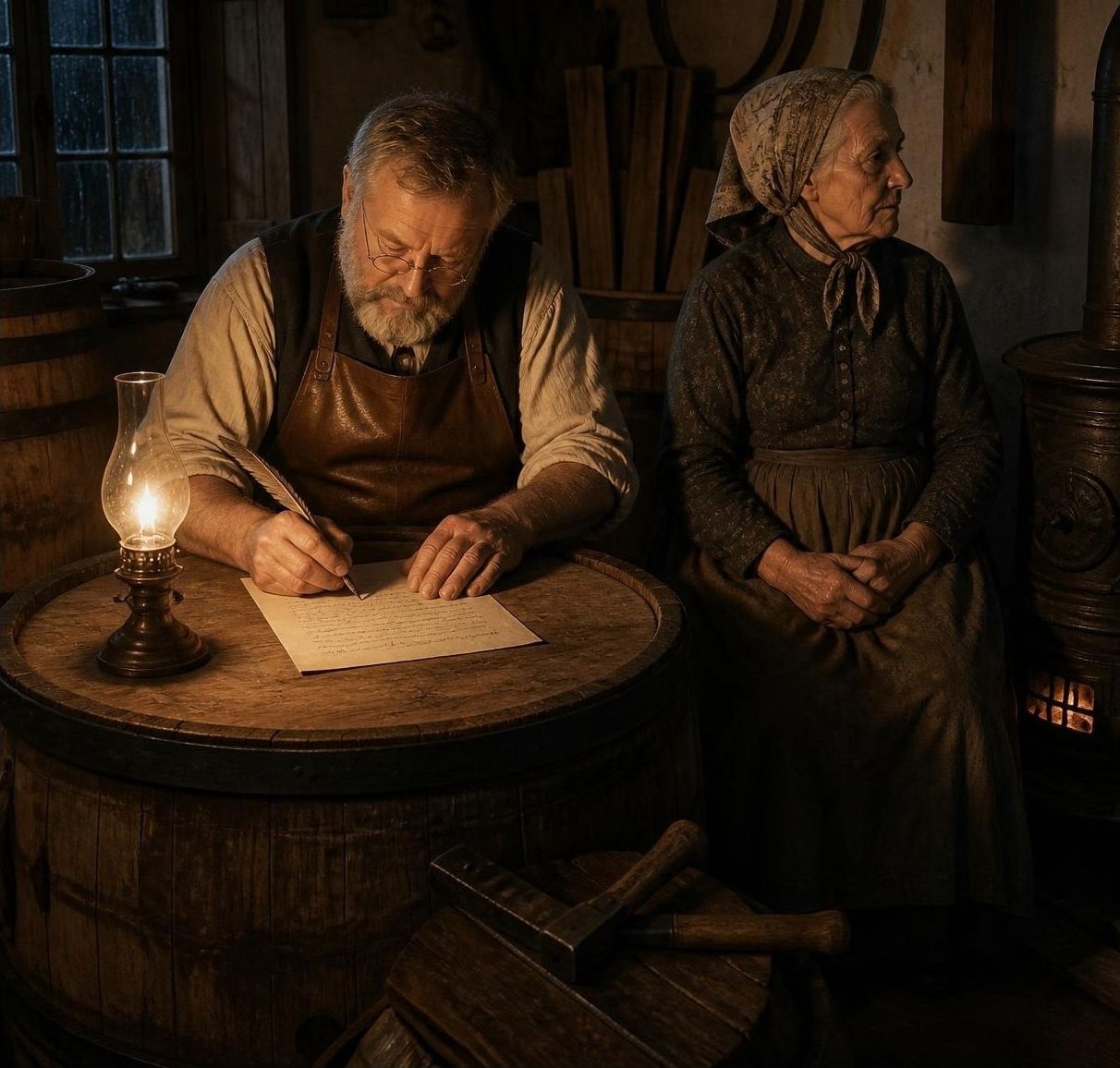
The Hagans found that paper and made the account of it you can read in the other place. That is the documents. This is what the town says.
V. The Hearth
Go to the Raupenhelm in Würzburg on a winter night, or any inn in that part of Franconia where there is a fire in the taproom and men who have been drinking since four.
Wait until the wind gets into the chimney.
If the fire crackles and pops, a snapping, a spitting, a sound like a man being struck, the room will go quiet. Someone will lift a glass. Someone else will say one word, and the glasses will meet, and every man in the room will take a good chug, not necessarily the whole glass, and turn his head, and spit to the side. A mock spit, mind you, dry and quick, out of the corner of the mouth, onto the floor.
The word is Namenlosen. The nameless. There is no grammar to it and no reason for any. Over the years it has been worn smooth, the way a coin is, and now it is just the word, the clink, the chug, the spit. They tell me it is the Hexenkommissar's scream. They are drinking to his damnation, and they do it without saying his name, because nobody remembers it, because that was part of the curse and part of the justice.
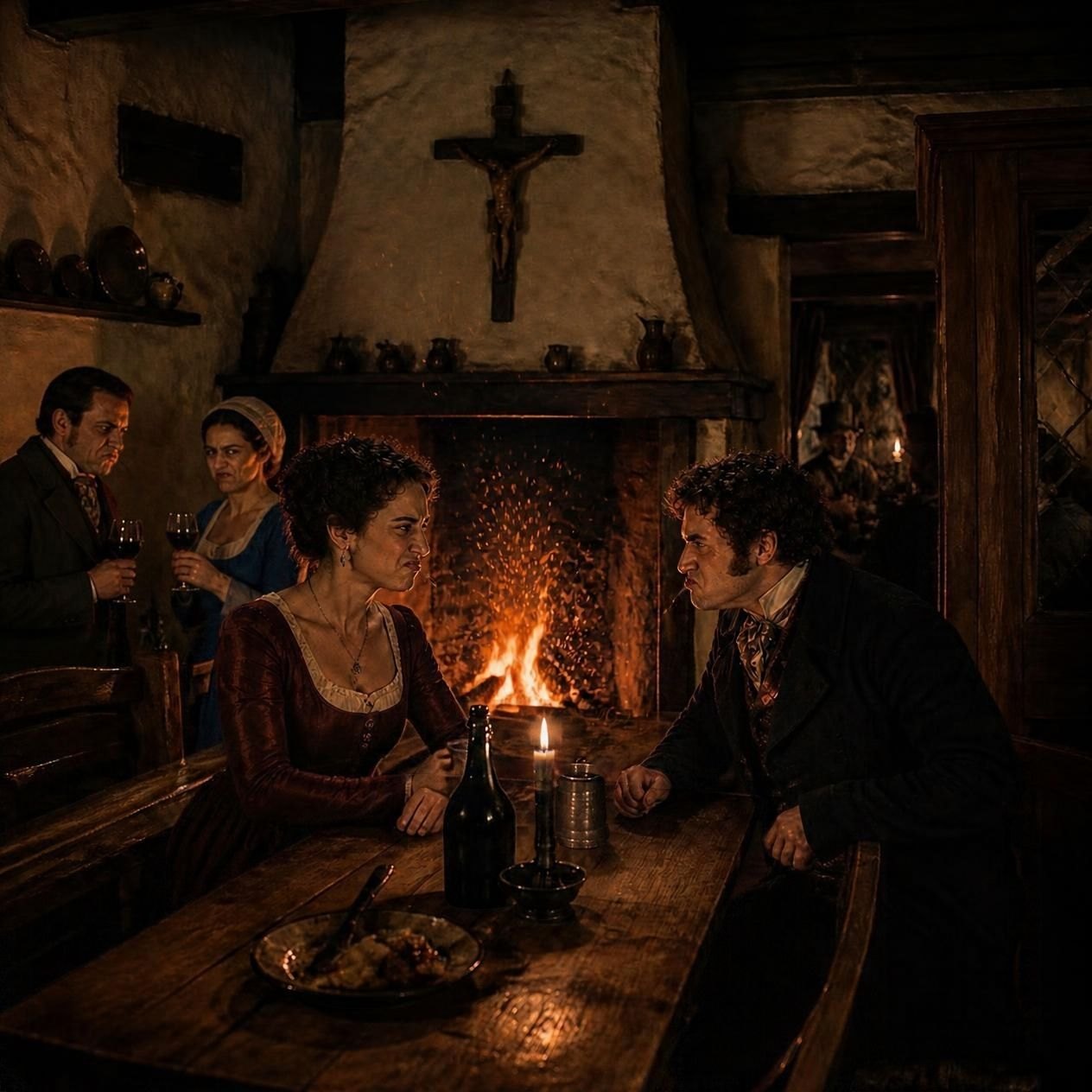
If the fire does not crackle but dances, if it leans and winks and the light goes bright along the wall, that is something else. That is a woman laughing. Then they drink slowly, to her, to Maria Renata, the subprioress, and they say her name softly and in full, once, and the glasses go down on the wood without a sound.
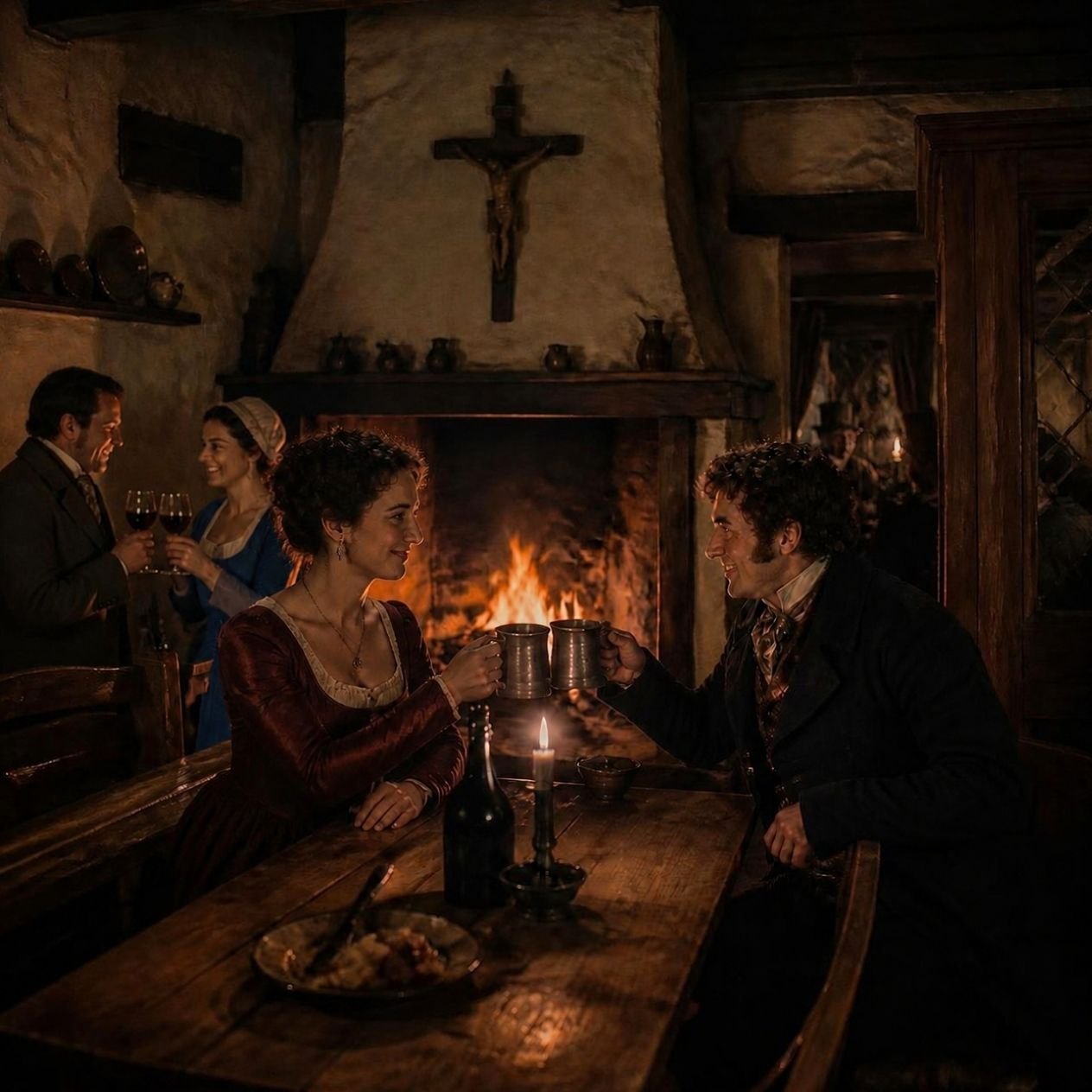
None of it is said to a priest. None of it is said to a magistrate. The ones who tell it to a stranger, as I was told it, say they are only repeating what their grandmothers said at the fire, and that they would not know anything about any orchard.
The Hagans put the documents in a book. I have read it. It is a good book, and what is in it is true. The paper says she was given the sword first, as custom required. The town says he refused her that mercy, and the town has never once been moved by a paper. I do not adjudicate. I only note that one of them has a ledger, and the other has the whole of Würzburg to testify. The town's version and the book's version do not agree on the priest, or the nun's rank, or the number of loads, but they agree on the two things that matter: the man's name is gone, and nobody was ever punished.
I believe the wood. Nine loads, and then a tenth, and the old woman calling it as they stacked it. That is the one detail I would stake my reputation on, because it is the kind a town does not invent. A town invents a villain and a saint. It does not invent arithmetic.
And I will tell you what frightens me, since you ask. It is not the ghost. A man burned in an orchard is a story, and I have heard better ones. What frightens me is a town of three hundred households that all agreed on a single answer, and kept it for generations. And a girl who held her tongue forty-seven years, and then waited twenty more, and then had it written down in her husband's hand.
That is the kind of patience I do not wish to meet in the dark.

From the Archivist
Join the Archive mailing list
Occasional letters with new stories, early chapters and pictures from The Voss Papers. You can unsubscribe at any time.
The button opens a sign-up page. A confirmation email will follow; if it does not arrive within a few minutes, please check your spam or promotions folder. Voss Court Press LLC · 2875 W Ray Rd Suite 6 #105, Chandler, AZ 85224 · Privacy