A Short Story from the Archive
HMS Falcon
Captain Philip Voss, 1812 to 1821
Overmatched
HMS Falcon, On Station, Grand Banks, Autumn 1812
Captain Philip Voss surveyed his ship and crew for the fifth time that afternoon. He was thirty-three, tall, with a faint scar along the left cheekbone and grey-green eyes that did not wander. He walked the length of the ship at every change of watch and spoke to someone at every gun. He knew their names, and which of them had a wife waiting in Portsmouth and which had none. He was never hurried and never loud, and a crew that had served under captains who were both had decided this was the better arrangement.
The United States had declared war on England back in June, and the Falcon had spent the autumn hunting American merchantmen running for home. Four prizes in as many weeks. Prize money always motivates a crew. Most of the crew was new to him, but two of the men who mattered most were not.
Lieutenant Reilly had stood at his elbow for much of the last seven years. He was a small man, quick with a sword, with a hawk's eye on the glass and a way of reporting bad news so flatly that Voss had learned to judge the weight of it from the tone alone.
Below, at the guns, was Mr. Oxley Hargrove, gunner's mate, "Ox" to anyone who had met him: six feet six inches tall and as quiet on his feet as a cat. At seventeen, still living with his parents on the Devon coast, he had stepped into the ring at the county fair, flattened the London bruiser who worked the boxing booth, and walked off with the guinea. Voss had never seen him lose his temper and had no wish to.
HMS Falcon was a fifth-rate post ship of the Royal Navy, carrying thirty-two guns: twenty-six 12-pounders on the main gun deck, four 6-pounders on the quarter deck, and two more on the forecastle. Ship-rigged on three masts and carrying the full spread of canvas, she had a complement of about two hundred thirty officers, seamen, and marines. She was fast enough to chase and shallow enough to work a hostile coast, but she could not stand in the line of battle against a French seventy-four, nor was she expected to. Her work was intelligence, raiding, and the landing of men on hostile shores in the dark.
The crew was a small, tight community in which a man's competence, or lack of it, was immediately visible to everyone aboard. There was nowhere to hide on a vessel of that size, and no margin for error on the kind of work the Falcon was assigned. The men who served her well knew each other with an intimacy that larger ships rarely produced. It is perhaps this, as much as anything, that explains the loyalty Captain Philip Voss inspired in those who sailed with him.
The Falcon was one frigate among more than seven hundred ships in the mightiest navy on the planet, and every man aboard was proud of it. The United States Navy had only a handful of frigates, and few observers on either side of the Atlantic expected American seapower to do more than make a brief, doomed gesture before the coastline was shut.
He did not know they were not normal frigates.
The lookout sighted the sail in mid-afternoon, and Reilly kept his glass on her for the better part of an hour. About an hour before dusk he said, without excitement, "Captain. American frigate, closing fast."
"Thank you, Mr. Reilly," Voss said.
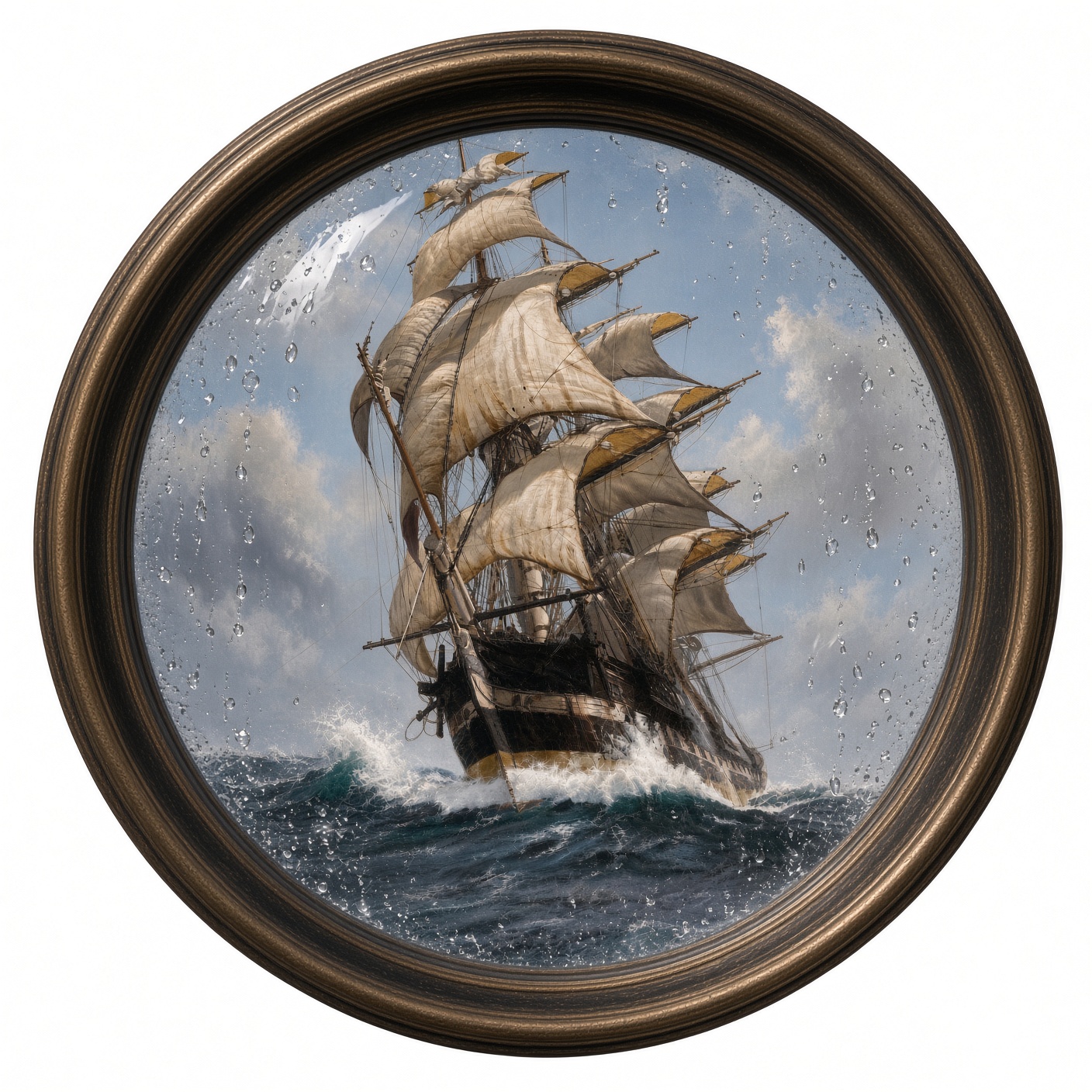
American Frigate! Closing Fast! Nicolas Pocock, 1813.
He kept his voice calm because he knew he set the tone. A level voice steadied two hundred and thirty men, and a captain who never raised it would be heard, the one time he did, by every man aboard.
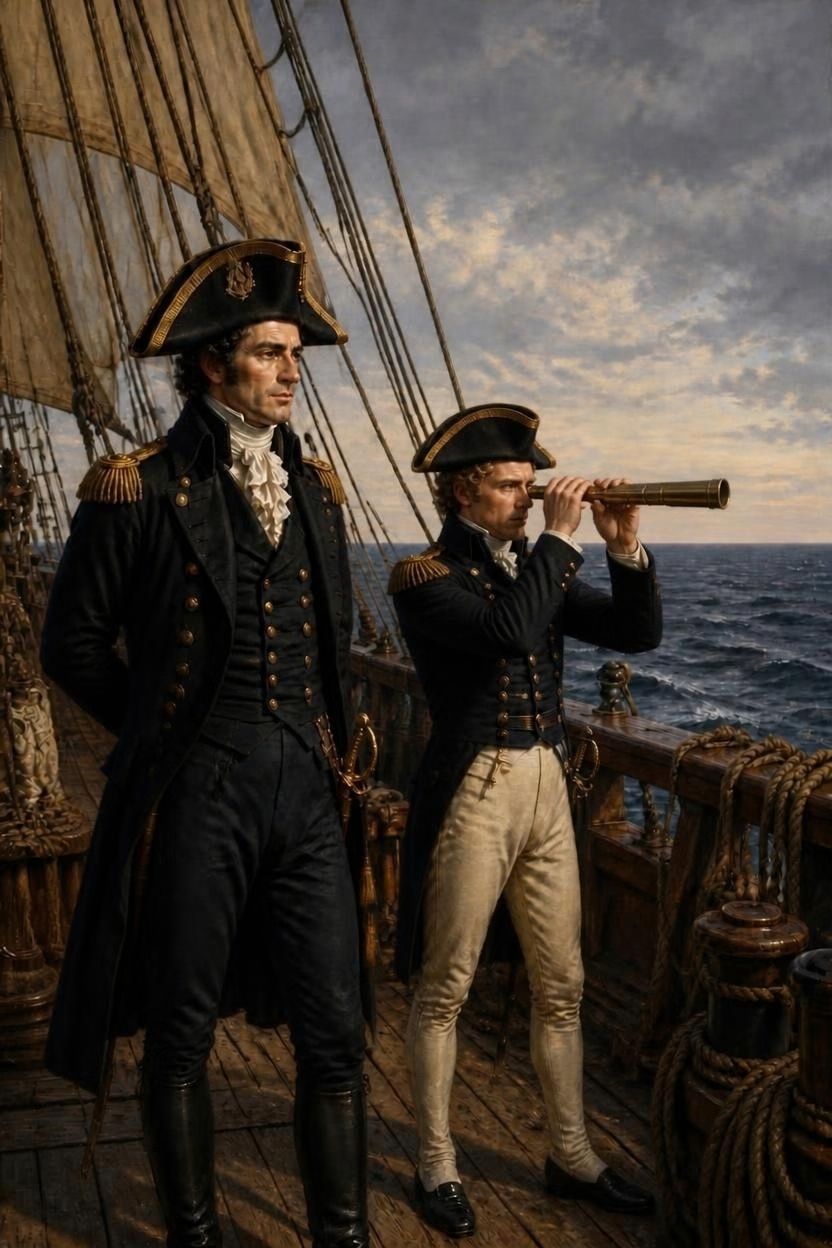
All is calm: Voss and Reilly on the quarterdeck, Grand Banks, autumn 1812.
The drum beat to quarters. The cabin bulkheads came down and went into the hold, sand was thrown on the deck, the slow matches were lit in their tubs, and the surgeon's boys carried their instruments down to the cockpit. By the time the American's gun ports opened, Voss had counted them twice and stopped liking the number.
Falcon's first broadside went out cleanly, and Voss watched it land through his own glass. The twelve-pound shot struck the American's hull and bounced away into the sea. The answer came low and heavy, and the Falcon shuddered the length of her keel, as if a ship of the line had struck her. One exchange had shown him what the Admiralty's own listings did not admit: the ship facing them had been built to a scale no frigate had any right to.
If he could not hurt her hull, he could still slow her. Voss raised the speaking trumpet and gave up any pretense of calm.
"Main deck! Cease firing! Sponge and load! Chain shot! Elevate for her rigging, aim for her masts and yards! Fire on the upward roll!"
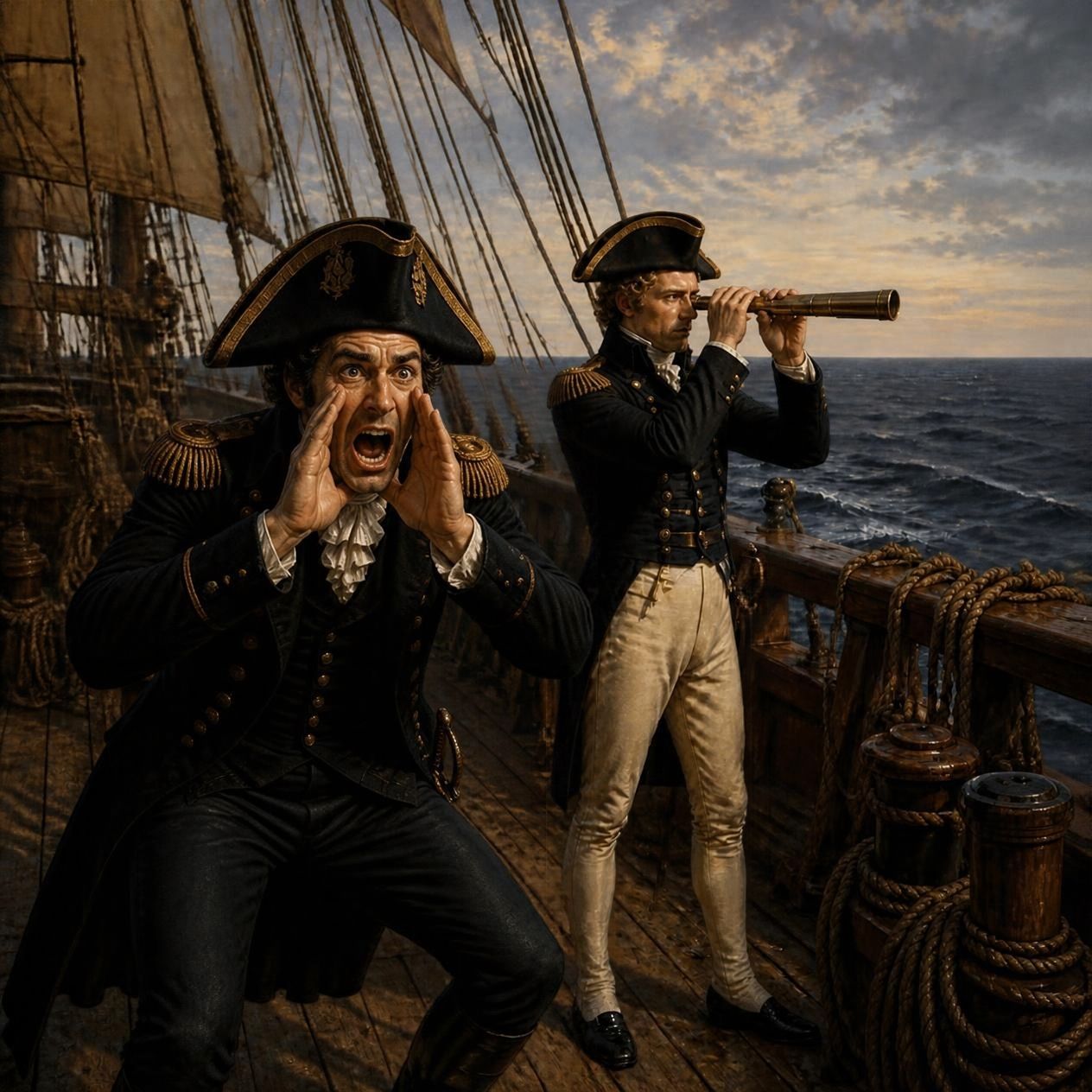
Load chain shot!
It was the first time any man aboard had heard him shout, and they knew what it meant. The ship seemed to draw one breath, and then everything moved faster.
Below, Ox took the order up like a man lifting a cask and sent it down the length of the gun deck in a voice that needed no trumpet. "Chain! Chain shot! Sponge and load! Up with the muzzles, her rigging, lads, her rigging!" The next broadside went out as pairs of iron half-balls linked by lengths of chain, shrieking as they spun. Voss saw the American's mizzen topsail shred, a brace part, a topgallant yard hang crooked against the sky. It was something. It was nothing like what came back.
The American's third broadside found the foremast.
It began to lean slowly, so slowly that for a moment it seemed to be considering the matter. Then the shrouds parted one after another with cracks like musketry, and the whole mast came over the side, yards, canvas and stays together, carrying the topmen and the marines from the fighting top a hundred feet down to the sea. Voss saw them fall. For a heartbeat he could tell the faces apart, mouths open, arms flung out, tangled in rope and sail and each other. Then the water took all of them in a single white burst, and what came up afterwards was wreckage and a few heads and a sound he never afterwards described.
The wreck, still fast by its lines, dragged at the ship's head and began to pull her round into the American's guns.
"Cut it away," Voss said.
He said it quietly, and it was worse than the shouting had been. Axes rose and fell along the rail. Reilly lowered the glass slowly. Some of the men in that tangle were still alive, and every one of them knew what the axes meant.
Below, the guns that had been firing steadily began to fall silent, first one, then another. Voss felt it through his boots before he understood it. A midshipman came up the main hatch, white to the lips, to make his report. He opened his mouth, shut it, and said only, "The main deck, sir." Voss did not ask him to go on. Water ran from the scuppers the wrong color.
"Helm up," Voss said. His voice was level again. "Set everything that will draw. We are leaving, Mr. Reilly."
He had to hope the coming dark would hide them rather than stay and hand the enemy a prize. The American's last broadside fell astern, and the Falcon ran for the dusk under her main and mizzen alone.
Voss expected to see the American's topsails follow them out of the gloom. He watched until it was too dark to see. They never came. He could only guess at the reason, but it was a good one. The chain had done what the shot could not. The American had come up into the wind with her mizzen topsail yard shot through, half her braces cut and her fore topgallant a rag, and her captain was not going to chase a cripple into the night with his own rigging in ribbons. His topmen would be aloft until midnight. By morning the sea was empty. The hull shot had bounced. The chain had bought them the night.
• • •
In the dark the ship's carpenter and sailmaker made repairs extensive enough that she could limp to the naval yard at Halifax. Below, Ox had the ugly task of sorting out and separating what a single ball had done to a crowded gun crew, so that every man could have his own shroud for the burial at sea. He did not speak while he worked. Sometimes he had to make a best guess.
Duty
His Majesty's Naval Yard, Halifax
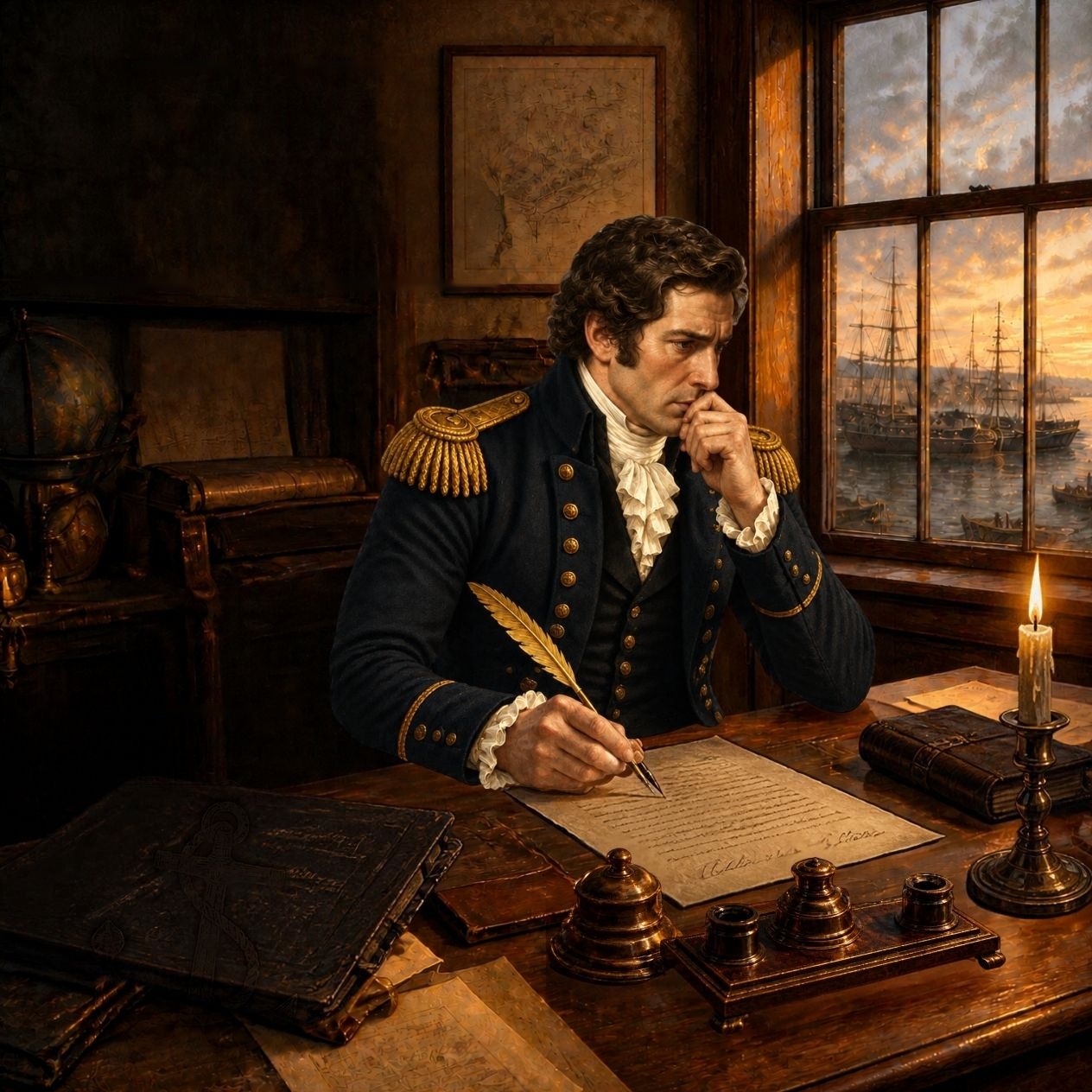
Voss writes his report. His Majesty's Naval Yard, Halifax.
Voss's own report of the action ran to a page and a half, said a great deal about the enemy's weight of fire and almost nothing about his own conduct, and set down his recommendation in plain terms:
"On the strength of what I personally observed, no frigate of ordinary rate should be expected to engage one of these American vessels alone with any reasonable prospect of success, regardless of the skill or courage of her own crew. The Board may wish to consider whether these ships are more properly met in future by two of our own frigates together, or by a single ship of the line, and whether any one frigate should again be required to operate independently, as this officer was. I saw no advantage in continuing an action in which the disparity of force had become plain, and withdrew my ship accordingly."
The Admiralty clerk who copied it into the fair book underlined that last line without being asked to.
It was not the language of a man asking for credit, which was very likely why he got some. The autumn of 1812 had already cost the Navy two humiliating single-ship losses to these same American frigates, and an officer who had recognized an unwinnable fight for what it was, fought it anyway long enough to do his duty, and brought his ship home largely intact was not a story the Admiralty was inclined to let pass unremarked. Voss was never decorated for it; there was, properly speaking, nothing to decorate a retreat for.
Voss did not deceive himself about what an honest report of this kind could cost a man. An officer who told the Admiralty, over his own signature, that its own frigates could not stand against an American one, could as easily find himself relieved of his command as thanked for it, quietly finished, the blame for an unwelcome truth settling on the messenger because it could not be made to settle anywhere else. So be it, he thought, sealing the letter. It was his duty to report what he had seen, not to soften it into something more comfortable for other men to read. The fleets had to be warned, whatever it cost the man doing the warning.
The Admiralty, London, 10 July 1813
The order itself, when it finally came, arrived more slowly than the problem it addressed. On the tenth of July, 1813, the better part of a year after Falcon's own engagement and many months after Voss's report, John Croker, First Secretary to the Admiralty, wrote to every station commander-in-chief in terms that read remarkably close to the language Voss himself had used: that no frigate of His Majesty's Navy should attempt, single-handed, to engage the large class of American ships, "which, though they may be called frigates, are of a size, complement, and weight of metal" that made any such engagement unequal from the outset. British frigates were henceforth to wait for the support of a squadron, or the presence of a ship of the line, before offering battle to one of these vessels at all.
Voss would be rewarded eventually, in other ways and for other services, which belong elsewhere in this account.
Artistic License
East Gallery, Voss Court, 1821
Nine years after the Grand Banks, the two canvases arrived from London in a single long crate, and Ox and Voss had the good sense to wait until the household had gone to bed before unrolling them properly across the long table, where there was room enough to stand back and look.
The room had an audience of its own. The Lawrence duel hung on one wall, the Pocock of the American frigate closing fast on another, and on the third the Géricault, which the household had learned not to look at directly. (The Lawrence would one day travel a good deal farther from this room than anyone standing in it could have guessed.) The fourth wall had a bare stretch of paneling.
The first was all gold and rose: Falcon under full sail into a sunset that turned her canvas the color of a struck match. The second was the same ship, hours or years later by the look of her, driving into darkness with her foremast gone and a black wound stove into her side, lit by nothing but a last streak of moon between cloud. J.M.W. Turner had signed them both in the corner, small and unapologetic, the way a man signs something he already knows will outlast every objection anyone is about to raise to it.

Turner's first canvas: Falcon under full sail.
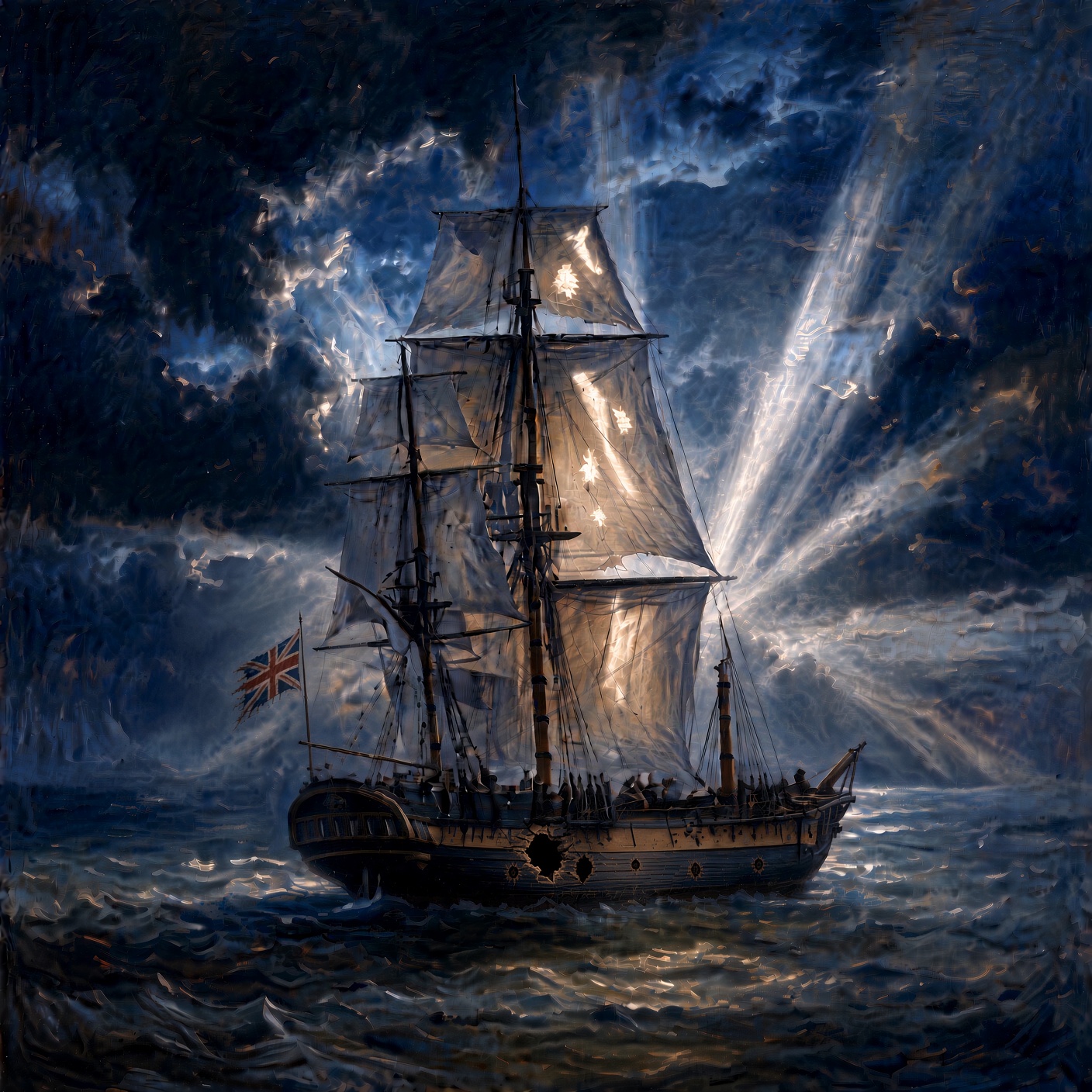
Turner's second canvas: Falcon after the action.
"That's not where the hole was," Ox said, after a while.
"It is not," Voss agreed.
"And it was never that size. You could have put your head through the one he's painted."
"I could have put my whole self through it, the way he's painted it." Voss leaned closer, hands behind his back, the old habit of a man inspecting a gun deck rather than a picture. "Mast's wrong too. We lost the fore, not the main."
"Rigging's wrong generally."
"Rigging's wrong generally," Voss said, and they went on like that for some time, two old men picking a masterpiece apart plank by plank, the way they had once, by all accounts, picked apart considerably more dangerous things together. Turner's generosity with the facts was by then a byword in every wardroom that had ever sat for him; a man did not commission Turner for an accurate record of his ship, he commissioned him for what the ship had felt like, and on that count neither of them had a single complaint to register.
It was Ox who found the last one, tracing a thick finger along the flag at the stern of the second canvas.
"And this is wrong and all. Union Jack. Should have been the white ensign."
Voss looked, and for a moment something crossed his face that was not about rigging or shot holes at all. "So it should." He was quiet a moment. "Smaller too. A proper ensign's no more than a quarter that size, flying off a ship that size. He's given her something a first-rate would carry."
Ox studied it a while longer, head tilted, the way he'd once studied a gun crew's work before passing judgment on it. "Maybe," he said finally, "but it's the right size in our hearts."
Voss looked at him. Looked back at the painting. Looked at him again.
"Ox," he said, "you are absolutely right." He was already turning toward the far wall, to the bare stretch of paneling that had been waiting, unremarked, for something to fill it for longer than either of them cared to say aloud. "We'll put them there," pointing. "Where everyone coming through that door will see them first."
• • •
Falcon's story is a small part of a much larger one. Volume One of The Voss Papers, Remember Them, follows Voss, Ox and Eleanor, and Élise, Wilkinson and Bainbridge, from the Nile to New Orleans. Volume Two, Sarrat's Glare, follows the Hundred Days. The opening pages of both are on the site.
From the Archivist
Join the Archive mailing list
Occasional letters with new stories, early chapters and pictures from The Voss Papers. You can unsubscribe at any time.
The button opens a sign-up page. A confirmation email will follow; if it does not arrive within a few minutes, please check your spam or promotions folder. Voss Court Press LLC · 2875 W Ray Rd Suite 6 #105, Chandler, AZ 85224 · Privacy