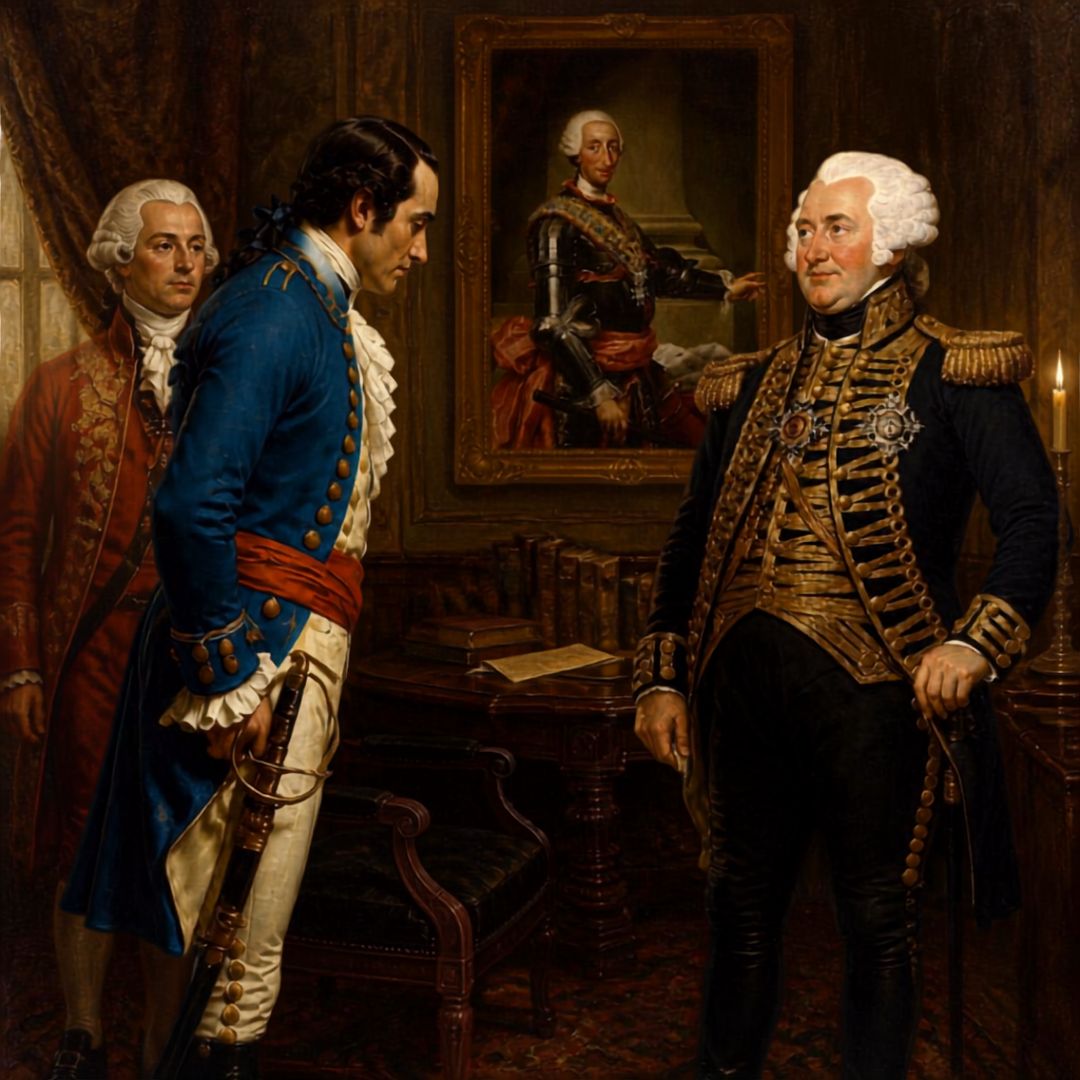
James Wilkinson swears allegiance to Spain at Governor Miró’s house, 1787. Painted by Ilya Repin, 1883.
Governor Miró’s House
F-M Endnote: On Ilya Repin, and What He Chose to Show
I want to give this canvas its own proper reckoning, since I do not think this archive has asked any single painting in the whole collection to carry quite this much quiet menace before.
Repin was born in 1844 in Chuguev, in what is now Ukraine, to a family of modest military settlers, and clawed his own way into the Imperial Academy of Arts in St. Petersburg only on a second attempt, graduating in 1871 with the Academy’s own gold medal. His breakthrough was already under way: Barge Haulers on the Volga, begun in 1870 and finished in 1873, a canvas of eleven exhausted men dragging a barge upstream that the critic Vladimir Stasov rightly called an artist plunging headfirst into the actual heart of ordinary Russian suffering, at a time when almost no one in the country’s own art establishment had dared take so unflinching a subject seriously. He studied afterward in Paris, admired the Impressionists without ever quite becoming one of them, and returned home convinced that Russia’s own realism needed to stay rooted in Russian subjects and, in spirit, considerably closer to Rembrandt than to anything currently fashionable in France. He joined the Peredvizhniki, the Wanderers, in 1878, the loose fellowship of realist painters who broke from the Academy specifically to bring honest subjects to a wider public through traveling exhibition, and who found in Repin, very quickly, their own most technically accomplished member.
This canvas was painted in 1883, the same year Repin began what would become his own most psychologically merciless work, Ivan the Terrible and His Son, in which a father stares in unbearable horror at what his own hand has just done to the child he loved. I do not think it is coincidence that this archive’s own commission arrived from the same brush, in the same year, since the two paintings share a method even where they differ completely in subject: Repin’s particular, unmatched gift for making a single face in a quiet room carry the entire moral weight of the scene, while everyone else present simply watches it happen.
Miró’s face is doing exactly that work here. This archive will not pretend to know with certainty what Repin intended by the particular set of the Governor’s mouth, the flat, appraising stillness of his own eyes, but I do not think “contempt” is an unreasonable word for it, and I do not think the reader needs any further instruction from this archive to see it once it has been named. Wilkinson, by contrast, is dressed for a rank he does not presently hold, gold and braid considerably in excess of anything his actual situation in 1787 entitled him to wear, a man arriving to sell something and dressed, whether he knew it himself or not, exactly like a man trying to look more valuable than he actually was. Supervía stands a half-step behind him, present at the introduction he arranged and already, visibly, no longer the man most responsible for what happens next.
The detail in the portrait behind them, Charles III’s own painted hand gripping the frame of his own picture in a manner that reads, to more than one visitor who has stood in front of this canvas since, as something closer to recoil than repose, this archive will not claim as certain artistic intention on Repin’s own part. I raise it only because the family itself has told the story that way for longer than anyone now living can properly account for, and I have come to think that a detail a family keeps telling itself, generation after generation, earns a kind of truth of its own regardless of what the original painter actually meant by it.
• • •
F-M Endnote: On Anton Raphael Mengs, and the King Who Watched
The portrait hanging behind the three men in Repin’s own canvas is not an invention. Anton Raphael Mengs painted Charles III many times across the two decades he served as the King’s own principal court painter, and a version of that image, copied and distributed through the ordinary machinery of Spanish colonial administration, would have hung in a great many official rooms considerably less significant than a governor’s own drawing room in New Orleans.
Mengs was born in Bohemia in 1728, trained from earliest childhood by his own father, a court painter himself, and was already producing pastel portraits of real accomplishment by the age of sixteen. He was made a painter to the Saxon court in Dresden at seventeen and its first painter before he was twenty-two, left the post for Rome in 1751, and there formed the friendship, beginning around 1755, that would shape the remainder of his career more thoroughly than any single teacher had: Johann Joachim Winckelmann, the great theorist of Neoclassicism, whose own conviction that art should return to the “noble simplicity and quiet grandeur” of the classical world Mengs absorbed completely and spent the rest of his life translating into paint. Contemporaries called him, without much exaggeration, the German Raphael, and more than one serious historian of the period has judged him the most internationally respected painter alive in Europe at the height of his own career.
Charles III brought him to Madrid in 1761, and Mengs served him, with two extended returns to Rome in the middle of it, until his own death in 1779, decorating royal palaces and producing the kind of formal state portraiture this particular image represents: restrained, dignified, more interested in conveying a monarch’s own settled authority than in flattering him with any Baroque excess. By the time this specific copy reached New Orleans, Mengs himself had been dead the better part of a decade, and Charles III, in the actual year Wilkinson stood beneath this portrait swearing an oath he had no intention of honoring, had barely a year of his own reign remaining to him, entirely unaware that a Kentucky general he would never meet in person had just pledged an allegiance to his own crown worth exactly as much as the paint the King’s own image was rendered in.