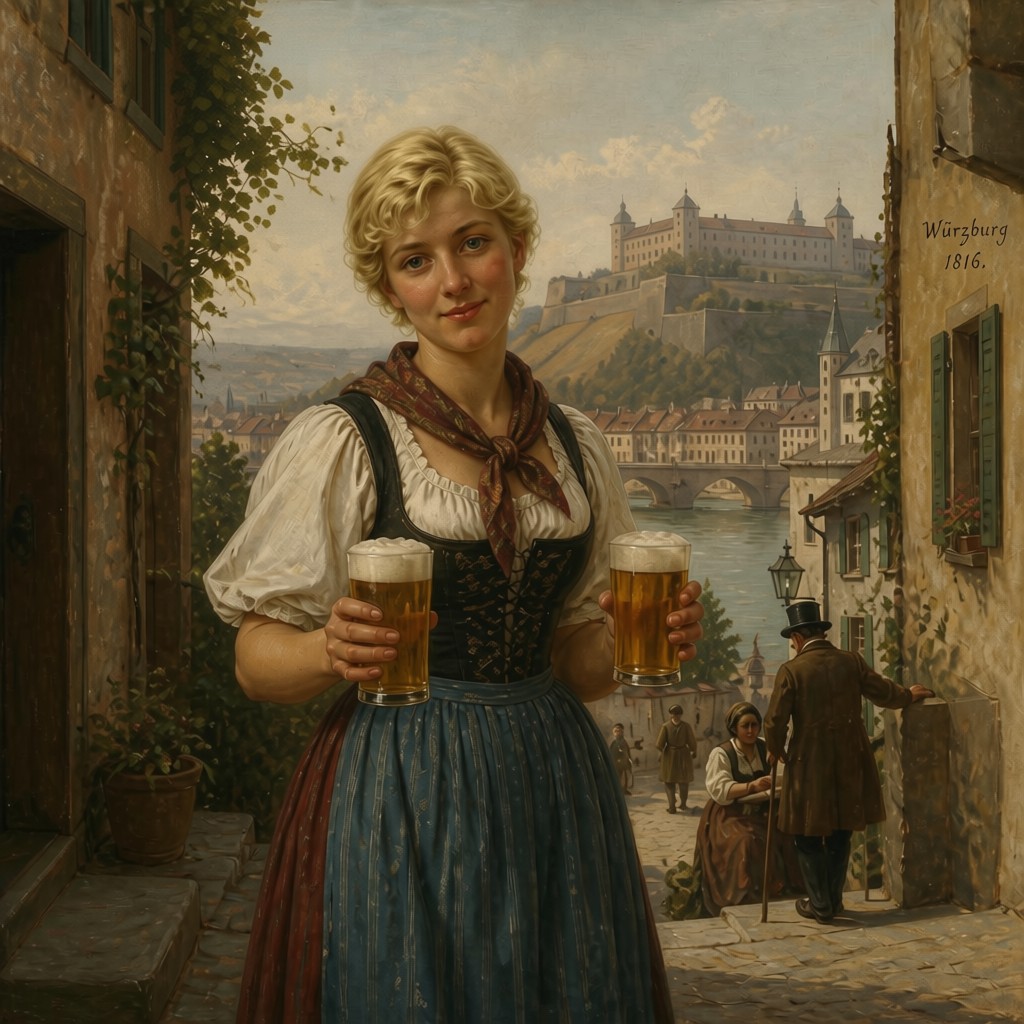
Anna
The Raupenhelm, Würzburg
Blonde-brown hair kept short, medium height, slim and athletic, with striking green eyes. Late twenties.
Widowed when her husband died at First Polotsk in August 1812, Anna was recruited into a intelligence network that predates the war she lost him to by the better part of several centuries, traced, if the family's papers are to be believed, back to Würzburg's own Prince-Bishopric when he ruled the land both spiritually and seculary. She carries what the network itself calls the Bishop's Favor, only 100 of theses coins were ever made.
"...my lime-washed walls, simple, low cost, have withstood changing fashion since before the Alte Brücke was standing."
F-M Endnote: On Anna, and a Date That Doesn’t Quite Hold
I want to address the inscription in the corner of this canvas before I address anything else about it, because I do not think it survives close examination, and I would rather the reader hear that from me than discover it independently and wonder what else in this archive has gone unchecked.
The painting reads “Würzburg, 1816.” I do not believe it. The woman in this canvas is not twenty-five, which is what Anna Kessler was in the year the inscription claims. She is a woman closer to thirty-five: fuller through the face, settled in a way twenty-five rarely is, with the particular composed handsomeness of someone who has survived a decade of running an inn, raising children, and marrying a man she once merely fed information to alongside his beer. I do not think Spitzweg painted this from an 1816 sitting at all. He was eight years old in 1816, and by 1826 only a pharmacist’s apprentice who would not take up painting in earnest for several years more, so whatever he made of her, he made it from someone else’s sketch, and made it long afterward. I think that sketch was taken a full decade after the date on the canvas, during the Voss family’s own Grand Tour of 1826, when their considerable traveling party passed through Würzburg and, in all likelihood, stopped at the Raupenhelm itself, the same inn that had been Anna and Hagan’s own professional and romantic beginning a decade before. Ten years and, by every account, several children into her marriage by then, she remained, whoever held the pencil that day, evidently well worth the sketching.
Why Spitzweg then labeled the finished canvas 1816 rather than 1826, I cannot say with certainty. I suspect it was simply the more romantic date to attach to her: the year the story of her and Hagan actually began, rather than the year a traveling family happened to catch her likeness in passing. A painter selling nostalgia does not always let the truth of his own reference material stand in the way of the date that sells the feeling best.
The view behind her is its own small deception, and a more forgivable one. The Raupenhelm itself stood on the opposite bank of the Main from this vantage, so Spitzweg could not, strictly, have painted the Alte Brücke and the Marienberg fortress rising together behind her from that particular doorway, and I do not believe he much cared. Both are the single most recognizable silhouette in all of Würzburg, and a painter working for a family who wanted the town itself instantly legible to anyone who ever hung the canvas on a wall elsewhere had every reason to move a bridge and a fortress a few hundred yards for the sake of the composition. I find I cannot object to this particular liberty as strenuously as I object to the date. A wrong year misleads the reader about who this woman was. A borrowed view merely tells them, correctly, where she belonged.
Her fuller story is still being prepared for the archive. A small scene from her Raupenhelm years is held for readers of the mailing list.